
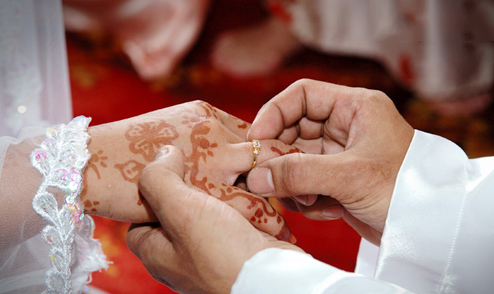
 The nikâh termed mut’a is null and void. Mut’a nikâh means a temporary marriage contract made between a man and a woman. To realize it the man proposes to the woman to lend herself to him for a certain length of time in return for a certain sum of money and the woman accepts it (if she likes to) without any witnesses.
It is written in all the books of Tafsîr and Fiqh that the twentyfourth âyat-i-kerîma of Nisâ sûra, which purports, “… Seeing that ye derive benefit from them, give them their dowers as prescribed;…” does not imply mut’a nikâh. It implies the mahr, i.e. the money (which the bridegroom has to pay the bride during the Islamic contract of marriage called) nikâh. For instance, the âyati- kerîma quoted above is explicated as follows in the twenty-sixth page of the Tafsîr-i-Baydâwî, and in its annotation entitled Tafsîri- Shaikhzâda: “This âyat-i-kerîma is about nikâh, which is canonically legal (in the Islamic religion). It does not legitimize
mut’a nikâh. As a matter of fact, it commands the payment of mahr. The kind of nikâh termed mut’a was canonically legal formerly. Later, it was prohibited. Islam does not approve of a temporary contract performed in the name of nikâh.”
Mawlânâ Ekmeluddîn [Muhammad bin Mahmûd Bâbertî] provides the following explanation in the two hundred and thirtyfirst page of the book Inâya, which is a commentary of the book Hidâya, which was written by the great scholar Burhânaddîn Merghinânî ‘rahimahullâhu ta’âlâ’: The nikâh termed mut’a is null and void. Yes, it was formerly legal in Islam, as is reported by Abdullah ibn Abbâs. Yet the Ashâb-i-kirâm declare unanimously that later it was proscribed in hadîth-i-sherîfs. In fact, they quote the hadîth-i-sherîfs in which it is proscribed. For instance, Muhammad ibn Hanafiyya narrates as follows: “My father, Imâm Alî, ‘radiy-Allâhu ’anhumâ’ related: On the very day when the fortress of Hayber was conquered [in the seventh year of the Hegira], Rasûlullah ‘sall- Allâhu ’alaihi wa sallam’ proscribed the mut’a nikâh.” In the face of this report on the authority of Imâm Alî, could Imâm Ja’far Sâdiq, who was a most beloved member of the Ahl-i-Bayt, ever be imagined to have commanded the mut’a nikâh?
Rebi’ bin Maysara ‘radiy-Allâhu ’anh’ relates: On the day we conquered Hayber, the Messenger of Allah ‘sall-Allâhu ’alaihi wa sallam’ made the mut’a nikâh halâl (permissible) for three days. My paternal uncle and I went to a house where a woman lived. Both of us wore overcoats made from thin cloth. My uncle’s
overcoat was of a better quality. The woman, a non-Muslim (ahli- kitâb), came to the door. She looked at my coat and noticed that I was younger. “This man’s coat is not like the other one’s; nor is his youth, though,” she said, and ushered me in, thus forgoing the coat for the sake of the youth. I spent the night there. In the morning I heard Rasûlullah’s town-crier announce in the streets: “O Muslims! The Messenger of Allah ‘sall-Allâhu ’alaihi wa sallam’ has forbidden the mut’a nikâh.” So we all ceased from the
mut’a nikâh.
That the Messenger of Allah prohibited the mut’a nikâh as he was alive is a fact unanimously acknowledged by the Sahâba. This unanimity, (which is termed Ijmâ’,) does not make changes or amendments in the religious principles, but it discovers and announces the changes and amendments that are made by the âyats or hadîth-i-sherîfs which cancel the religious principles put
by other âyats or hadîth-i-sherîfs previous to themselves. Especially with the hadîth-isherîf quoted on the authority of Alî ibn Abî Tâlib by Imâm Mâlik bin Enes in Muwattâ, [the first book written on Hadîth].
Hadrat Alî ‘radiy-Allâhu ’anh’ is reported (in the book) to have
said, “On the day we conquered the fortress of Hayber, Rasûlullah ‘sall-Allâhu ’alaihi wa sallam’ prohibited
consumption of domestic donkey meat and practice of mut’a nikâh.” This is the end of the passage we have borrowed from thebook Inâya.
Mîzân-ul-kubrâ is another book in which it is written that the mut’a nikâh is null and void in all four Madhhabs.
Ref: This paragraphes are quoted from the book “The Sahaba The Blessed” page 170, which is the translation of the book Ithbât An-Nubuwwa written by Imâm-i Rabbânî ‘rahimahullâhu ta’âlâ,’ who was born in the city of Sirhind, India, in 971 H. (Hijrî) (1564 A.D.) and passed away there in 1034 H. (Hijrî), 1625 A.D. You can find the whole book and the other valuable books in the web site www.hakikatkitabevi.com.tr and download in PDF format for Adobe Acrobat Reader, EPUB format for iPhone-iPad-Mac devices and MOBI format for Amazon Kindle device.
Turkey Tribune