

While addressing members of the Parliament on the occasion of the opening of the new legislative year, Turkish President Abdullah Gül made very clear that nobody should dismiss him in predicting who will be the Çankaya Presidential Palace’s next tenant, who will be named in August 2014 elections.
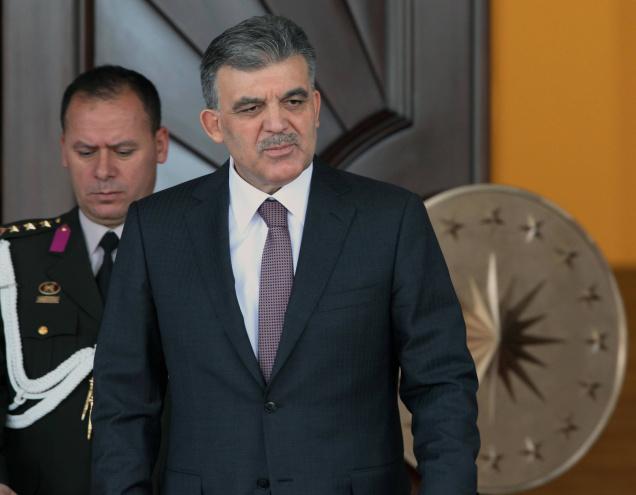 In a speech delivered Oct. 1, Gül underlined that it was his “last address … during my term,” and that following the end of his term, he would “continue to be in the service of our nation.”
Only days later, in an interview with private news television A Haber late on Oct. 3, Prime Minister Recep Tayyip Erdoğan also felt the need to deliver clear-cut remarks on the very same issue. Refuting suggestions that he and the incumbent president could come head to head in a showdown for the presidency, Erdoğan said: “I don’t believe there will be a decision that will lead to us parting ways. What I mean is we will do the necessary consultation and negotiation among ourselves if needed.”
As a matter of fact, through these remarks, both Gül and Erdoğan revealed the difficulty of making future plans for each of them while ignoring the other. In this way, they have also declared that they had to name the presidential candidate from the ruling Justice and Development Party (AKP) through “consultation.”
As there are various scenarios under given conditions, the results of local elections scheduled for March 2014 will be a decisive element in picking the final scenario.
The likeliness of the scenario of “one more term with Gül” rises when taking into consideration probabilities such as: Erdoğan, as such a dominant character, may not like to be at Çankaya with the current presidential authorities, especially when taking probable conflicts with Gül into account.
Or if there is a decrease in the ruling party’s votes in the local elections, he may prefer to offer an opportunity to Gül for a second term at Çankaya while taking the chances of not being able to get elected as president into account.
Actually, the delicate calculations over the next presidential elections are closely related to a Constitutional Court decision released in June 2012. With that decision, the top court dismissed an appeal by the main opposition Republican People’s Party (CHP) to end Gül’s term as of 2012, ruling that he could serve seven years.
The court also ruled that Gül could seek re-election in 2014, but only for a five-year term.
The dispute originated from government-led constitutional reforms approved in a 2007 referendum shortly after Parliament elected Gül as president in August 2007. Meanwhile, the constitutional reforms reduced the presidential term to five years, renewable once.
Parliament passed a law in January 2012 specifying that Gül’s term should end in 2014. Yet the CHP argued that the reforms should apply to Gül’s presidency, meaning that he should serve five years instead of seven.
Stances recently displayed by key players in the presidential scenarios show that the year 2014 will be a scene of a difficult chess game, probably prompting those players to make unpredictable moves.
Reform package may be modified
Prime Minister Recep Tayyip Erdoğan has signaled that the recently announced “democratization package” may be revised during debates at the Parliament. Whispers confirm the accurate interpretation of this signal, as they say that through proposals for amendment to be submitted by the ruling Justice and Development Party (AKP), changes in both the Turkish Penal Code (TCK) and Anti-Terror Law (TMK) will be adopted, paving the way for the release of members of the Kurdistan Communities Union (KCK), the alleged urban wing of the outlawed Kurdistan Workers’ Party (PKK), in custody. Some leading aides to Erdoğan oppose such amendment, arguing that it will decrease the AKP’s votes in the eastern Anatolian region. Yet, the last word is up to the prime minister.
Şentop may quiT charter panel
Mustafa Şentop of the ruling Justice and Development Party (AKP), who has been working as a member of the Parliament’s Constitution Conciliation Commission since the beginning, may have to leave the panel in November if the Commission cannot finalize its work by then. The reason for this is that Şentop, a deputy chair of the AKP, is serving within the party as director for election affairs and local elections will be held in March 2013. “After November, the election calendar will begin and our work at the party will be intensified,” Şentop told the Hürriyet Daily News. “It is not possible for me to continue with the Commission under these conditions. Maybe we will assign another colleague of mine,” he said.
HDN