

Syria’s New Legal Framework Takes Shape
Syria’s interim president, Ahmed Shara, has signed the country’s new interim constitution, reinforcing separation of powers and the role of Islamic law in governance. This moment represents a major step in the nation’s transition after the fall of the Bashar al-Assad regime.
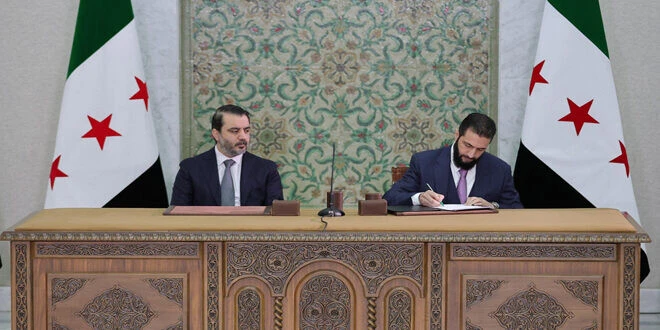
Official Signing Ceremony in Damascus
The signing ceremony took place in Damascus, where the interim constitution drafting committee, National Dialogue Conference members, Syrian Scholars Union President Usama Rifai, and Foreign Minister Asad Hasan Shaybani participated.
The document confirms Syria’s official name as the “Syrian Arab Republic” and mandates that the head of state must be Muslim. It also establishes Islamic jurisprudence (Sharia) as the primary legislative source, ensuring adherence to separation of powers.
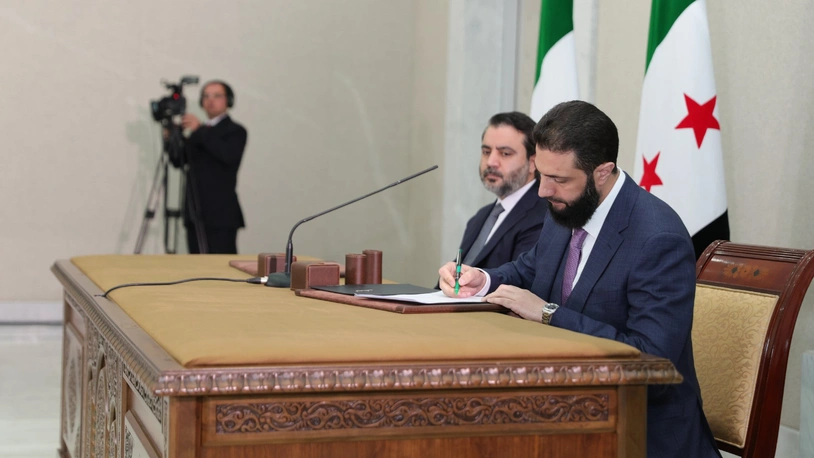
Key Articles of Syria’s Interim Constitution
State Sovereignty and Governance
- Article 1: Syria remains a fully independent and sovereign state. Its territorial integrity is protected.
- Article 27: The president holds the roles of head of state, armed forces commander, and chief executive authority.
Islamic Law and Religious Freedoms
- Article 2: The president must be Muslim, and Islamic law serves as the foundation of legislation.
- Article 7: Religious communities have the right to govern personal status laws according to their faiths.
- Article 6: All citizens receive equal rights, with no discrimination based on race, religion, gender, or ancestry.
Political and Economic Structure
- Article 8: The economy operates under social justice, free competition, and anti-monopoly principles. The government supports investment and sustainable growth.
- Article 14: Political participation and party formation are permitted. A commission will draft a new party law.
- Article 20: The People’s Assembly, appointed by the president, serves as the legislature until parliamentary elections occur under a permanent constitution.
Fundamental Rights and Freedoms
- Article 13: The state guarantees freedom of speech, press, and media, regulated to maintain public order.
- Article 15: Human rights receive legal protection in accordance with international conventions.
- Article 35: The judiciary functions independently, with judges adhering strictly to legal and ethical principles.
- Article 36: No individual faces punishment without a legal ruling, and extraordinary courts will not be established.
Social Justice and Welfare
- Article 16: The government protects families as the foundation of society, offering support for motherhood and childhood.
- Article 17: Women’s rights and societal roles are safeguarded, ensuring protection against violence and discrimination.
- Article 18: The state guarantees children’s rights, shielding them from abuse while ensuring access to education and healthcare.
A New Chapter for Syria
The interim constitution establishes Syria’s political transition, blending Islamic law, democratic principles, and human rights. It strengthens the separation of powers, promotes religious freedoms, ensures judicial independence, and fosters economic stability. The next stage involves implementing these laws and drafting a permanent constitution.