
A new strategic mission for the OTS
The Organization of Turkic States (OTS) was founded to deepen economic, cultural, and political cooperation across the Turkic world.
Yet shifting regional security dynamics have added a new and urgent mission: collective defense.
In recent years, Eurasia has witnessed growing instability, from terrorism to border conflicts and great power rivalries.
These developments have pushed Turkic nations to consider closer military coordination.
The idea of forming a common defense mechanism or institutionalizing defense cooperation within the OTS is now central to its long-term vision.
This evolving strategy reflects a broader transformation.
The OTS no longer limits its “deeper integration” goal to trade or transport—it now seeks to build a shared security identity.
Following Azerbaijan’s victory in Karabakh, Turkic states have embraced a more proactive regional role.
A common military framework would not only meet defense needs but also consolidate the Turkic world’s strategic identity and regional influence.
Building collective defense and deterrence
Establishing joint defense cooperation under the OTS would mark a historic step toward regional solidarity and strategic autonomy.
By aligning their military capabilities, Turkic countries could strengthen deterrence and enhance their collective resilience.
The OTS region spans Central Asia, the Caucasus, Anatolia, and the Caspian Sea—an area rich in energy routes and critical corridors.
Securing this geography means securing the balance of power across Eurasia.
A joint military structure would enable faster responses to terrorism, cyberattacks, trafficking, and cross-border threats.
Collective exercises, technology co-production, and unified defense training would institutionalize the cooperation already seen between Turkey and Azerbaijan.
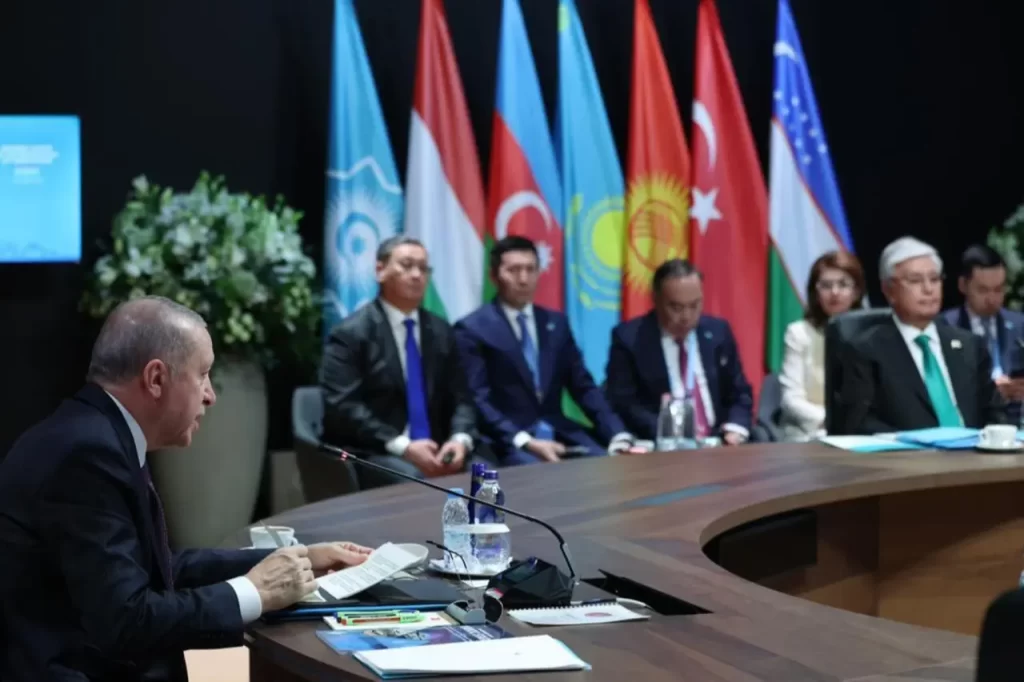
The 12th OTS Summit in Gabala, Azerbaijan (Oct. 7, 2025), highlighted this vision.
President Ilham Aliyev proposed holding a joint military exercise in 2026—transforming long-discussed ideas into practice.
This initiative could become the foundation for a future “Turkic Force” or “Joint Defense Mechanism.”
Such integration would allow the OTS to evolve beyond a cultural alliance into a vital pillar of Eurasian security, shaped by the Turkic world’s own priorities.
Expanding geopolitical influence and autonomy
A strengthened OTS defense framework would redefine the Turkic world’s role in the global order.
Located between Asia and Europe, member states hold vast geopolitical importance for trade, energy, and logistics.
However, this central position has also exposed them to external rivalries.
Developing a shared security architecture would reduce outside interference while enhancing regional influence.
It would align foreign policies, ensure coordinated crisis responses, and promote joint defense strategies—especially in regions such as the Caucasus and Central Asia.
Turkey’s advanced defense industry—ranging from drones and armored vehicles to missile systems—offers a foundation for joint production.
Such projects would boost technological independence and strategic self-sufficiency for all OTS members.
Beyond defense, this process must be institutionalized.
Creating bodies like a Joint Defense Council or Crisis Management Center would ensure long-term cooperation.
In this way, the Turkic world could emerge as a stable, self-reliant actor capable of setting its own regional security agenda.
Toward a unified security identity
The push for a joint OTS military structure signals more than strategic necessity—it represents a shift in global perception.
By pooling their defense capabilities, Turkic nations can secure peace within their borders and stability across Eurasia.
This transformation would elevate the OTS from a cultural platform into a cornerstone of regional security and balanced global order.