

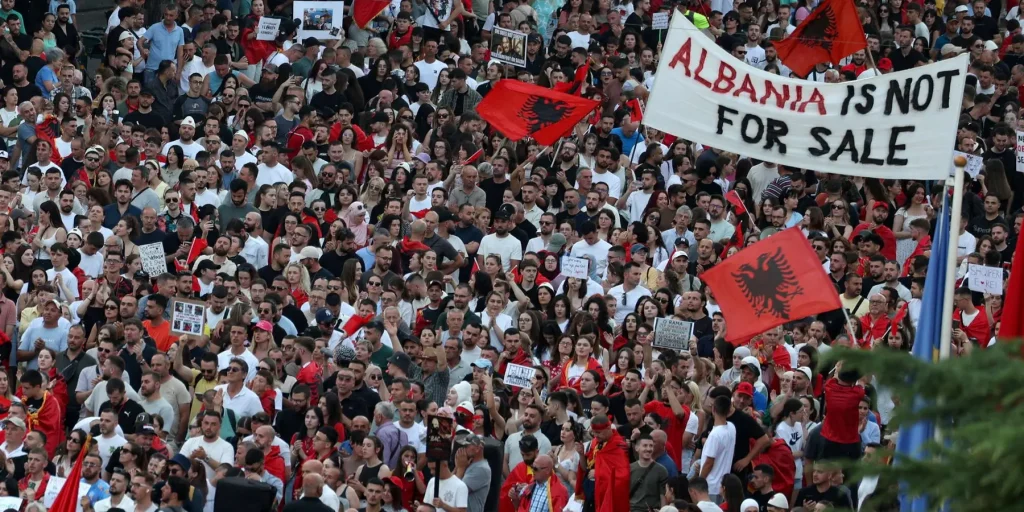
Albania’s “Flamingo Revolution” Grows Against Trump–Kushner Luxury Resort Plans. Protests over Sazan Island and the Vjosa-Narta coastline have expanded from an environmental campaign into a wider confrontation over public land, property rights, political influence and the rule of law.
Protests are intensifying in Albania against luxury tourism developments associated with Ivanka Trump, the daughter of United States President Donald Trump, and her husband Jared Kushner.
At the centre of the controversy are Sazan Island, a former military outpost off Albania’s western coast, and a largely undeveloped stretch of shoreline surrounding the Vjosa-Narta protected landscape near the villages of Narta and Zvërnec.
Sazan, Albania’s largest island, was closed to the public for decades while it served as a military base. Today, its abandoned bunkers and military installations form part of the country’s historical heritage, while the surrounding waters and nearby wetlands support some of the Mediterranean’s most sensitive ecosystems.
The dispute, however, is not limited to one island. It concerns two closely associated but legally distinct development plans: a luxury resort proposed for Sazan and a much larger tourism complex envisaged along the mainland coast near the Vjosa-Narta wetlands.
Strategic investor status granted
On December 30, 2024, the Albanian government granted “strategic investor” status to Atlantic Incubation Partners LLC, a company connected to Kushner’s investment network, for a luxury development covering approximately 45 hectares of Sazan Island.
The island project has been presented as an investment worth around €1.4 billion. Its supporters say it could create approximately 1,000 jobs and help transform Albania into an international destination for high-end tourism.
Prime Minister Edi Rama’s government has promoted the plans as part of a wider strategy to attract wealthy visitors and large-scale foreign investment.
Environmental organisations, local residents and civil-rights advocates argue that the controversy cannot be reduced to tourism or economic development. They say the projects raise serious questions about changes to protected-area boundaries, restrictions on public access to the coast, disputed property ownership and the absence of transparent consultation.
For many protesters, the issue is no longer simply whether Albania should build another resort. It is about who controls the country’s coastline, who benefits from major investments and whether environmental and property laws can be altered for politically connected investors.
Ivanka Trump’s “discovery” story draws anger
Public anger grew after Ivanka Trump described how she and Kushner first encountered Sazan Island during a boat trip.
Speaking on a podcast, Trump said they had stopped for a swim, reached the island and hiked barefoot to its summit. She said they were immediately captivated by what they saw and later began developing a vision for the area.
Her description of the island as something they had effectively “found” or discovered was criticised in Albania.
Opponents said the story presented Sazan as an empty landscape awaiting transformation by foreign investors, while ignoring its military history, cultural memory and environmental significance.
To Ivanka Trump, the island may have appeared to be an extraordinary real-estate opportunity encountered during a yacht trip. To many Albanians, however, Sazan and the surrounding coastline are part of a shared national inheritance that cannot simply be converted into an exclusive destination.
Barbed wire, machinery and private security
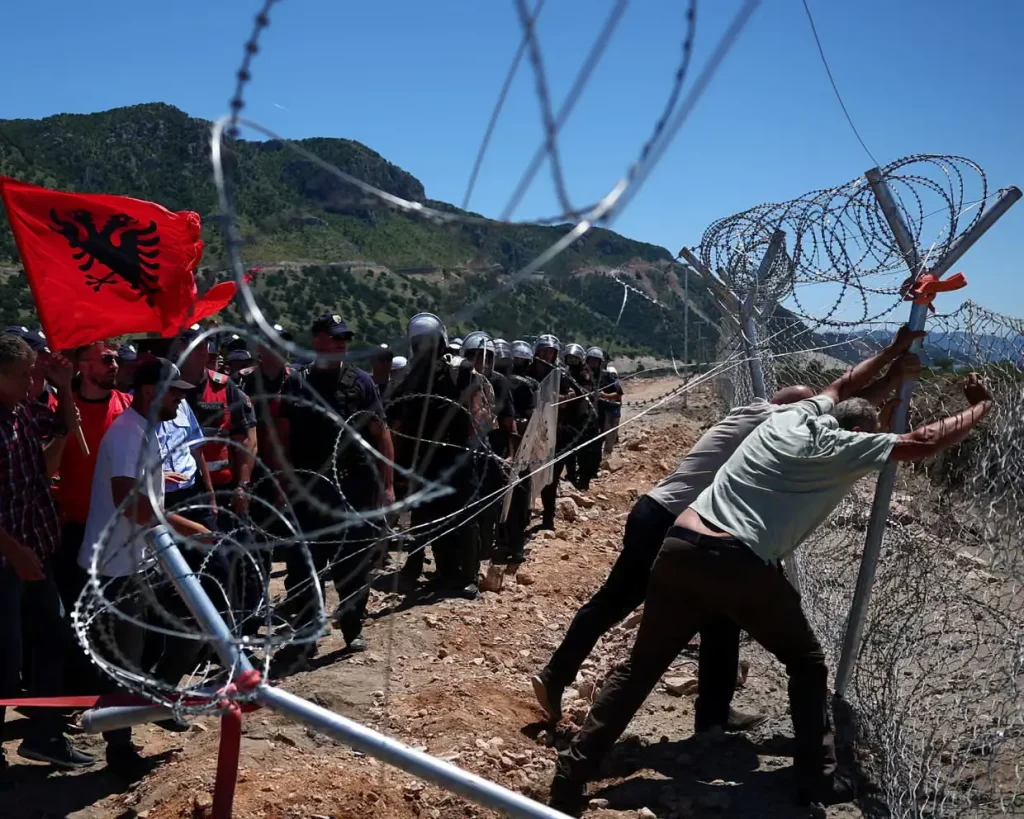
The protest movement accelerated at the end of May after residents and environmental activists reported the arrival of heavy machinery, construction crews and private security personnel near Zvërnec.
Concrete-based fencing topped with barbed wire was installed around parts of the proposed development area. Local residents said the barriers restricted access to beaches, agricultural land and coastal areas they had used for generations.
Environmental groups reported damage to sand dunes, pine forests and natural habitats as access roads and preparatory works progressed.
Some residents also claim that land incorporated into the project was sold or transferred despite unresolved ownership disputes. Several villagers have produced deeds and tax documents that they say support their claims, although the rightful ownership of the contested plots has not yet been legally determined.
Reuters reported that it found no evidence of wrongdoing by Kushner in connection with those individual property disputes. Nevertheless, the unresolved claims have added another layer to public anger over the development.
The controversial fencing was later removed, with Rama himself describing its installation as a disgraceful decision. By then, however, the dispute had already spread from the coast to the streets of Tirana.
Flamingos become the symbol of resistance
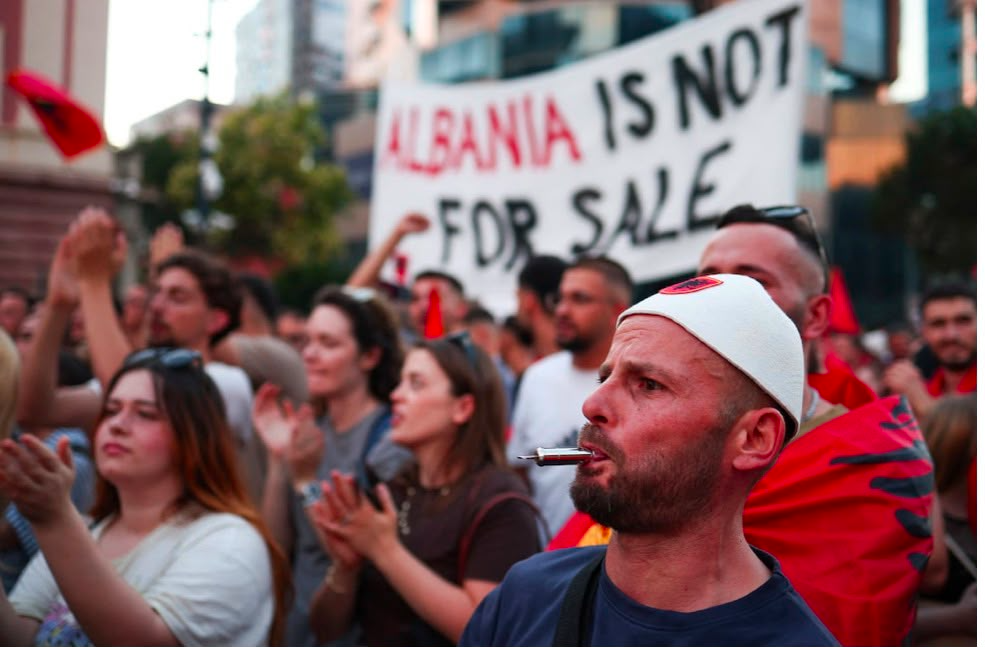
Thousands of people have taken part in demonstrations in the Albanian capital and other cities.
Protesters have carried signs reading “Albania Is Not for Sale,” “Cancel the Project” and “Ivanka Go Home.” Some have called not only for the developments to be halted but also for Rama’s resignation.
Pink flamingos appearing as inflatable figures, costumes, drawings and placards—have become the defining symbol of what activists now call Albania’s “Flamingo Revolution.”
The Vjosa-Narta area forms part of a major migratory route and supports more than 200 species of birds, including flamingos and Dalmatian pelicans. The wider landscape contains lagoons, dunes, salt marshes, pine forests and river-delta habitats, as well as nesting and feeding grounds used by sea turtles, seals and other wildlife.
Conservationists describe it as one of the remaining places where the Mediterranean coastline can still be seen before intensive tourism development transformed much of the region.
The protesters’ flamingos therefore represent more than one threatened species. They have become a symbol of public resistance to the privatisation and commercial transformation of Albania’s remaining undeveloped coastline.
“This is no longer only an environmental issue”
Aleksandër Trajçe, executive director of the Protection and Preservation of the Natural Environment in Albania, has accused the authorities of failing to provide meaningful public consultation, accessible permits or adequate documentation.
According to Trajçe, negotiations can only begin after machinery and fences are removed and damaged habitats are restored.
He has described the situation as unprecedented in Albania’s protected regions, arguing that construction-related activity appeared to begin before the public was given clear information about environmental assessments and planning permission.
Activists say this lack of transparency has transformed the dispute.
What began as a campaign to defend wetlands and bird habitats has become a broader debate about public access, private property, government accountability and the rule of law.
Anti-corruption prosecutors open an investigation
Albania’s Special Structure Against Corruption and Organised Crime, known as SPAK, has opened an investigation into controversial decisions made in 2024 concerning protected-area status and land ownership.
The inquiry is examining changes that helped clear the way for tourism development around the Vjosa-Narta landscape.
The investigation does not by itself establish criminal responsibility on the part of Kushner or the project’s other investors. However, it has intensified scrutiny of the decisions taken by Albanian institutions before work began.
The European Union has also expressed concern about the potential consequences for wildlife and protected habitats—an especially sensitive issue for a country seeking EU membership by 2030.
Rama says the investment will continue
Prime Minister Edi Rama continues to defend the development.
Rama says Albania should not fear ambitious international investments and argues that luxury tourism can create jobs, increase state revenue and prevent the country from remaining dependent on low-cost mass tourism.
He denies that the projects will destroy the coastline and insists that environmental protections will be respected.
Although Rama offered to meet representatives of the protest movement, he has also made clear that the investment will not be stopped while he remains in power.
When the project first emerged, Rama argued that Kushner should be treated as an American investor rather than merely as a member of the Trump family. More recently, he has warned that Albania must not acquire a reputation as a country where foreign investors are met with hostility.
Rama has also alleged that online opposition to the development has been amplified by bots, hostile foreign actors and antisemitic narratives. He has accused Iran of participating in a wider “hybrid war” aimed at destabilising Albania.
Iran has rejected those accusations, while protesters say Rama is attempting to discredit a domestic movement rooted in genuine concerns about land, corruption and environmental destruction.
A Political Profile Beyond Albania and the Shadow of Another Private Island
Kushner’s name carries political significance far beyond Albania’s tourism industry. As a senior White House adviser during Donald Trump’s first administration, he played a central role in shaping US policy toward Israel and the Middle East and was closely involved in the Abraham Accords. That record has influenced how some activists view his international business influence, although it does not constitute evidence that the Albanian investment is illegal.
The image of a secluded island being transformed for the benefit of politically connected elites has also drawn symbolic comparisons with Little Saint James, the private island in the US Virgin Islands once owned by Jeffrey Epstein. Epstein’s sexual exploitation and trafficking of underage girls, as well as Ghislaine Maxwell’s role in recruiting victims, are established in court records.