

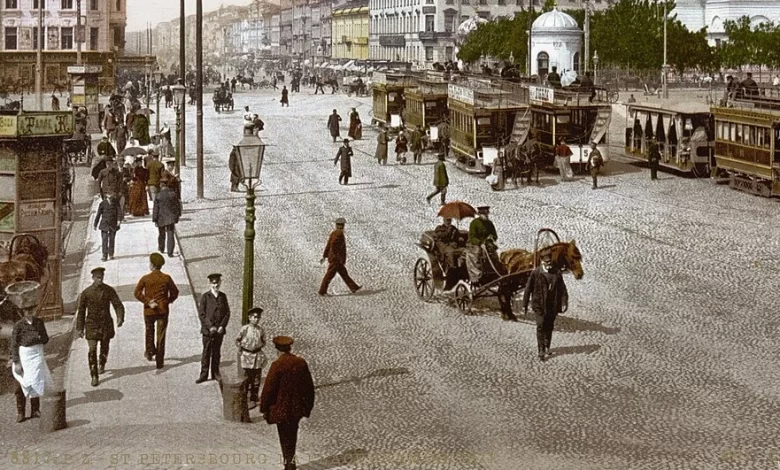
“There is no place more beautiful than Nevsky Prospect. At least, this is true for Petersburg. For Petersburg, Nevsky Prospect is everything. How it shines, this alluring, coquettish courtesan of our capital. I am absolutely certain that no inhabitant of Petersburg—whether an official or a civilian—would ever trade this street for the world.”
The work begins with Nikolai Gogol’s masterful depiction of Nevsky Prospect. Petersburg’s dazzling, captivating, charming Nevsky Prospect… Young women dressed in costly fabrics, noble families with their governesses, stern young officers from the middle and upper classes, cheerful clerks showing themselves off along Nevsky, craftsmen and merchants of various nationalities, apprentice boys running from one end of the street to the other…
Harmony and vanity on the boulevard
At first sight, the place creates the impression of harmony, as if it were a happy ground where all its inhabitants are courteous and caressing people.
“Nowhere else in the world do people greet each other as freely, as naturally, and as respectfully as they do on Nevsky Prospect. Nowhere else do you find such unique, artistic smiles—smiles so exquisite that at times they make you melt with delight, at other times they make you feel lower than the tiniest blades of grass, compelling you to bow your head.” says the author.
But the truth is otherwise. Beneath all this liveliness lies vanity. Ostentatious objects, people obsessed with appearances—falsehood has been concealed behind costly fabrics. Gogol pierces through this with a series of masterful depictions and biting dark humor, making heavy use of irony in the book’s opening.
Strange characters and daily life
“Here you will see conversations about last night’s concert or about the weather. But with what self-importance, with what noble dignity! Here, throughout the day, you encounter countless types and events beyond understanding. My God! What strange characters fill Nevsky Prospect! There are those who, upon meeting you, lower their eyes to your shoes, and once you have passed, turn their heads to examine the tails of your coat. Why they did this, I could never comprehend. At first I thought such people were shoemakers, but later I realized that most of them were government clerks; some of them even had the extraordinary skill of leaping from one government post to another. As for those who were not clerks, they were engaged in pavement engineering or reading newspapers in confectioneries; in short, most of them were quite sensible people.”
The painter’s tragic dream
The story then begins. In the first tale of Nevsky Prospect, Gogol narrates the clash between the city’s realities and the world of dreams. Perhaps in this first story his pen pays homage to his artistic friends—souls of depth and spiritual yearning, trapped in this superficial and self-serving city.
Like other Petersburg painters, Piskarev is sensitive and possesses a profound spirit. Unlike others, he has no desire for society’s approval. He understands nothing of flamboyant attire, and on the rare occasion he dons something costly, it sticks out awkwardly, like a patch.
Piskarev and the dark-haired girl
To him, wealth, power, or a luxurious coat that makes others gasp with envy mean nothing when compared with painting a dull, gray northern landscape. The only thing the painter seeks is to satisfy his soul.
The story begins when two friends walking along Nevsky Prospect catch sight of two women who draw their attention. The painter Piskarev, encouraged by his lieutenant friend Pirogov, parts ways with him to follow one of the women.
Piskarev begins to follow the dark-haired girl who has enchanted him. She is so beautiful that from that very moment Piskarev falls in love. This love seems to fill an emptiness within him.
From dream to despair
The more he follows her, the more his passion grows; childhood memories rush into his mind, and every gesture of the dark-haired girl fills him with inexpressible delight. Indeed, Piskarev suddenly loses his sense of reality. The bridge before him stretches and breaks apart, while the watchman’s hut at the top appears to tumble headlong.
By the time he reaches the place where she lives, the dark-haired girl has become, in his eyes, a sacred being.
“No earthly thought remained in his mind; the fire consuming him was no earthly fire; at that moment, he was an untainted, pure young man, overflowing with an undefined need for spiritual love. That which might awaken reckless thoughts in a libertine aroused in him, instead, loftier dreams. The trust shown by this delicate, beautiful being endowed him with a knightly firmness, and with a slave’s determination to fulfill her every command.”
The painter’s frenzied pursuit ends at the girl’s home. But this seemingly noble, aristocratic seventeen-year-old dark-haired girl is a prostitute, and the palace Piskarev had envisioned turns out to be a brothel. He enters the house, sits across from the girl in her room, only to discover that the very being upon whom he had conferred a divine, poetic significance is in reality vulgar, immoral, and insolent. When she finally opens her mouth to speak, the painter’s entire world collapses.
Illusions, opium, and a tragic end
Piskarev suffers a bitter disappointment. His pain is immense, but the real blow comes that night when he dreams of the dark-haired girl. In the dream, he attends a ball hosted by none other than the girl herself. In his dream she is the complete opposite of reality—noble, dignified, unattainable—exactly as he had imagined her, pure and lofty in spirit. She tries to convince Piskarev that she is not like the other women of the brothel. Yet she never manages to finish her words. When he wakes, Piskaryov is even more devastated. Again and again he tries to fall asleep and dream of her, but instead of dreams he finds only sleeplessness, and so he resorts to opium.
Under the influence of opium, he sees different women as if they were her, and in each case they assure him that he had not really stumbled into the brothel. After one such dream, he convinces himself that he might save her from this life, that all it would take is to reach out his hand to her. He goes to the brothel to speak to her, delivering a long moral lecture in hopes of persuading her. But she mocks him, and the others laugh. Driven nearly mad by this love, Piskarev can bear no more. Returning to his home, he locks the door and slits his throat.
Four days later, neighbors notice no one has entered or left the painter’s room. They break down the door and find his lifeless body. Perhaps because he was of no profit to anyone, no one but a government doctor and the local watchman attends his funeral; not even his friend Pirogov comes to bid him farewell.
The lieutenant’s shallow pursuits
In the second tale of Nevsky Prospect, the author turns to Pirogov. Through him, Gogol portrays society at large. The lieutenant is coarse, mocking, fond of display, and concerned with bodily rather than spiritual pursuits.
Pirogov and the blacksmith’s wife
On the very day when the painter Piskarev fell in love with the dark-haired girl, Pirogov had set his sights on the fair-haired woman who passed by them, leaving Piskarev behind to pursue her.
Unlike the painter, Lieutenant Pirogov sees the blonde as prey. He pesters her along the street with unwanted advances. Though she rebukes him harshly and shows her displeasure, he pays no attention. He is confident in himself: after all, he is an army officer, and in his mind, no woman has the right to resist him.
They reach the woman’s home. Pirogov follows her inside uninvited, only to be confronted by her husband—Schiller, a German blacksmith. Drunk, Schiller threatens the lieutenant and drives him out.
Pirogov feels insulted. Though he himself was at fault, entering the house with bad intentions, he cannot bear that a German blacksmith dared to scold and threaten him. No matter what, he vows to have the blacksmith’s wife, and the next day he goes to Schiller’s workshop. At first, the blonde greets him, but soon she calls her husband. Then Pirogov has the cunning idea of commissioning Schiller to make him a pair of spurs. In this way, he hopes to smooth over the previous day’s unpleasantness and gain easy access to the workshop, where he can continue his attempts to seduce the woman.
Schiller is a good craftsman
Schiller is a good craftsman—rough, burly, a simple man devoted to his work with German discipline, yet fond of money. Pirogov offers him much more than the usual price for the spurs and flatters him, and Schiller becomes friendlier toward him.
Knowing that Schiller is not home on Sundays, Pirogov turns up at the blonde’s door. Knowing German women’s fondness for dancing, he invites her to dance. Thus he hopes to display his own talents while gradually winning her over. Yet once the dancing begins, Pirogov loses control and tries to kiss her. The woman screams, and at that moment Schiller bursts in with two of his fellow craftsmen. Enraged, they strip the lieutenant of his uniform and throw him out into the street.
Half-naked, Pirogov flees the blacksmith’s house. Though guilty, he is furious that his honor has been so trampled. Along the way, he dreams of revenge on Schiller. Neither banishment to Siberia nor a flogging sentence seems enough to soothe his rage. Yet, as we have said, all of Pirogov’s experiences, even his wounded pride, remain superficial. After eating and drinking in a confectionery, he simply stops thinking about it. That evening, at another social gathering, he again dazzles the ladies with his dancing, having completely forgotten the incident.
Gogol’s allegory of Petersburg
Nevsky Prospect is a city allegory, written with Gogol’s graceful irony, that exposes the darkness hidden behind glittering shop windows. The author portrays, on one hand, a fragile artist longing to elevate his soul, and on the other, a lieutenant chasing worldly pleasures and shallow ambitions.
“Nevsky Prospect, from the outside, appears splendid, bright, and full of charm; but within, it conceals the hypocrisy and deceit of the human soul.”
Read Gogol – The Nose: Just an Organ, or a Crisis of Identity? by Ömer Faruk Güler