

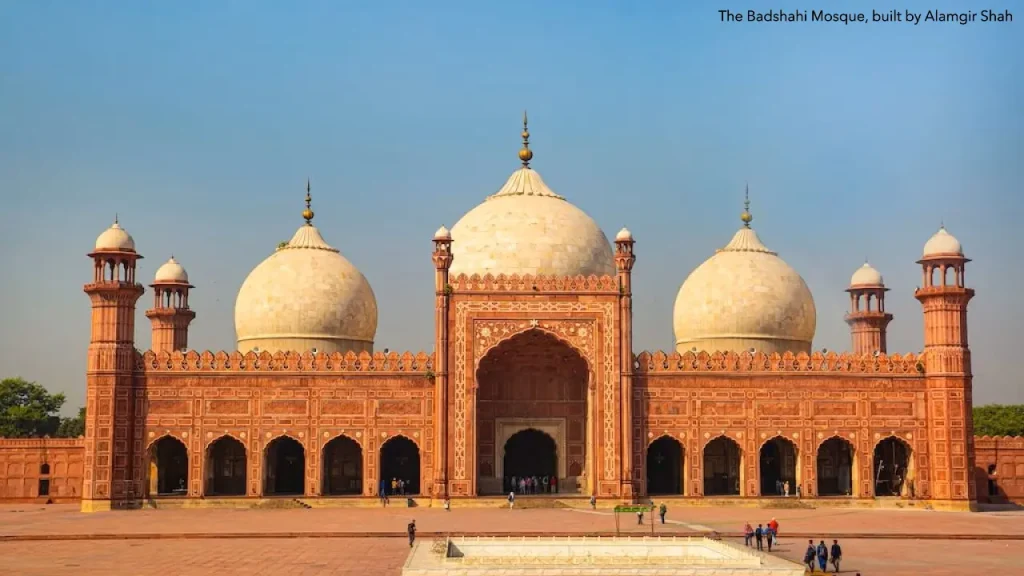
The spiritual bond between Hadrat Muhammad Ma’sûm and Alamgir Shah
India holds a very important place in Turkish-Islamic history. During the times when Turkish states ruled, great scholars, awliya, statesmen, and sultans were raised in India. Among those who were contemporaries and shared a spiritual bond, one was the great Islamic scholar and awliya, the qutb of his time (the greatest spiritual authority of his era) Hadrat Muhammad Ma’sûm ‘rahmatullâhi ta’âlâ ’alaih’, and the other was Awrengzib Alamgir Shah, the magnificent ruler of his era, like the Ottoman Kanuni Sultan Suleiman the Magnificent.
Hadrat Muhammad Ma’sûm is the third son of the great Walî and profound scholar Hadrat Imâm Rabbânî ‘rahmatullâhi ta’âlâ ’alaih’. He was born in 1599 in the city of Sirhind, India. He is the second greatest awliya of his time after his father. He is the twenty-fourth scholar and awliya of the chain called “Silsila-i Aliyya.” He memorized the Holy Qur’an in three months. He completed his education in all sciences at the age of 16. His father, Hadrat Imâm Rabbânî states in one of his letters: “In these days, my son Muhammad Ma’sûm has finished ‘Sharh-i Mawaqif’. He thoroughly understood the faults and errors of the Greek philosophers, and the benefit and profit were great. All praise and thanks be to Allahu ta’ala for these favors.”
His Influence and Extraordinary Number of Followers
In Islamic history, a scholar and guide (murshid) whose guidance and rectitude were as widespread as his has not been seen. Nine hundred thousand people followed him. Forty thousand of his students became wali and seven thousand became murshid-i kâmil (perfect guides), meaning very great scholars and awliya. His father, Hadrat Imam-i Rabbani ‘quddisa sirruh’, gave him the good news, saying: “You will be the qutb of your time.” Later, he himself confirmed this by saying, “All praise and thanks be to Allahu ta’ala. What was promised has been attained. I have reached what my father had announced.”
Sultan Alamgir Shah of the era was also one of the disciples (murid) and caliphs (khalifa) of Hadrat Muhammad Mas’ûm. He played a big role in his upbringing and was a complete follower of him. He would seek his prayers and listen to his advice and commands. His success and benevolent service in possessing a great Islamic state were thanks to the spiritual support (himmet), influence (tasarruf), and favor (tawajjuh) of Hadrat Muhammad Mas’ûm.
Life and character of Sultan Alamgir Shah
Alamgir Shah was born in 1618 in Dohad, Malwa. His mother was Begum Mumtaz Mahal. He was the third son of Shah Jahan and the 5th generation grandson of Babur Shah. He became Sultan on July 31, 1608, at the age of 40. He is the longest-reigning Turkish monarch on the throne. He ruled for almost fifty years, longer than the Ottoman Sultan Kanuni (Suleiman the Magnificent). He passed away in 1707 at the age of 90 in Ahmednagar.
He was buried in a place called Rawza. Alamgir Shah had four sons and three daughters. He received a very good scholarly and military education. He was excellently trained in horsemanship and martial arts. He was a complete scholar (alim) of Tafsir (Qur’anic exegesis), Hadith, and Fiqh (Islamic jurisprudence). He knew Turkish, Persian, Arabic, and Hindi very well. He also learned the art of calligraphy and earned the title of “Hattat” (Calligrapher).
Education, Character, and Leadership Style of Alamgir Shah
One of Alamgir Shah’s most important characteristics was his determination and steadfastness, coupled with complete courage, in achieving his goal. He displayed the same courage and success in the field of diplomacy as he did in the military field. He had a very good memory. He was also a tireless leader. The Italian doctor Gemalli Careri, who had the opportunity to meet him during his reign, noted that Alamgir would read every single petition submitted to him, answer them, and take great pleasure in this work.
Despite all the splendor of the state, Alamgir led a simple life. His clothing, attire, and all his other affairs were simple. He was very organized. When he passed away at the age of ninety, he had no physical infirmities. He loved to read. The book “Ruq’at-i Alamgiri” which compiled his letters, remained a common textbook for writing simple but beautiful prose for a long time. He was also talented in composing poetry.
Will Durant, who attacked almost all Indian-Muslim leaders with harsh language, could not help but make the following admission about Alamgir Shah: “He scarcely used punitive methods in going after crime and the criminal. He abstained from all food, drink, and extravagance forbidden by his religion”
Out of his reluctance to take money from the state treasury, he would write Mushafs (copies of the Qur’an) with his own hand and sell them to provide for his living. He became a hafiz (memorizer of the Qur’an) after becoming the ruler. He would perform the obligatory (fard) prayers in congregation as soon as their time entered. He never abandoned the congregation. He would definitely perform the Friday prayer in the Grand Mosque.
He spent his nights in worship (ibadah), remembrance (dhikr), recitation (qira’at), and contemplation (tafakkur). During the last ten days of the month of Ramadan, he would enter i’tikaf (spiritual retreat) in the mosque. He would fast on Mondays, Thursdays, and Fridays. He was always in a state of wudu (ablution), never neglected his dhikr, and recited many salawat (blessings upon the Prophet). He never abandoned the life of abstinence (zuhd) and poverty (faqr). He preferred barley bread.
Great Services Alamgir Shah Performed
Alamgir Shah performed very important religious and social services. He provided every means to a large committee composed of the country’s leading scholars and had large libraries established. To facilitate the legal affairs of Muslims, he commissioned the preparation of the “Fatawa-i Alamgiriyya,” which is one of the unparalleled services in the history of Islamic law, with the exception of the “Majalla” work of the Ottomans. He accepted this book of jurisprudence, named “Fatawa-i Alamgiriyya” after him but famous as “Fatawa-i Hindiyya,” as the Basic Law, or Constitution. These rulings, prepared according to the Hanafi school of thought (madhhab), were implemented throughout the country by just qadis (judges). He also authored a work on the science of Hadith. He annotated it and translated it into Persian.
The Jizya tax, which should be collected from non-Muslims according to Islamic law, had been abolished by Akbar Shah in 1564. By the order of Alamgir Shah, the Jizya began to be collected again in 1679. During his reign, he abolished eighty types of taxes, in unimaginable varieties and forms, that were not commanded by Islam and that brought in millions of revenue, from both believers and unbelievers. He won the hearts of everyone, Muslim and non-Muslim. Instead of the treasury weakening after these measures, it grew richer.
During his period as a prince (Şehzade), Sultan Alamgir worked for the development of the Hindu peasants of the Deccan, had extensive loans given to them to purchase seeds and animals, and seriously took up irrigation work. This behavior shows that he was not dogmatic.
In a decree he issued in early February 20, 1556, he stated: “It has been decided, in accordance with Islam, that temples which have existed for a long time shall not be destroyed. However, the construction of new temples shall not be permitted either. Our command is that henceforth you shall ensure that no one interferes with the affairs of the Brahmans or other Hindus in such places, contrary to Islam, and that they are not disturbed.” In 1663, he absolutely forbade the Brahman custom of a widow burning herself to ashes upon her husband’s death, which caused complaints among the adherents of this religion. Although this prohibition was considered interference in religious affairs by conservative Hindus, its purpose was humanitarian and for their own good.
Alamgir Shah removed the Kalima-i Tawhid (which indicates that no one other than Allahu ta’ala deserves being worshipped) written on coins due to the concern that it might be dragged underfoot.
He prohibited the “March 21st Nevruz” festival on the grounds of bid’ah (innovation in religion) as it was a Zoroastrian custom. Since his ascension to the throne was in the month of Ramadan, he declared the first day of this month as a festival. Musical instruments were banned in the palace; only the nawbat (court band) struck at specific times was permitted, which was for military purposes. During his reign, musicians buried their musical instruments and equipment in a thousand-person convoy.
It is recorded in the “Alamgir-nama” that he sent 63 thousand gold coins as nadhr (votive offering) to the sayyids (descendants of the Prophet), mujawirs (caretakers of holy sites), servants, and those performing i’tikaf (spiritual retreat) residing in Mecca and Medina. Furthermore, records mention that he took a close interest in the scholars of Transoxiana (Mâverâünnehir) and provided financial aid to the Turkish religious scholars in that region.
Alamgir Shah’s impact on society and conversions
According to the “Ma’asir-i Alamgiri,” Sultan Alamgir’s charitable works can be listed as follows:
He distributed cash aid to the needy, amounting to 9 thousand gold coins in Ramadan and slightly less in other months. He established soup kitchens for the poor in the capital city of Agra and many other provinces. He built caravanserais for travelers as rest stops. He had all mosques repaired from the state treasury. And by appointing imams, muezzins, and khatibs (preachers) to these mosques, he provided them with a permanent income, such as a salary. He provided aid from the state purse to scholars and students engaged in virtue and knowledge.
Public Perception and the Spread of Islam Under Alamgir Shah
The Muslim populace accepted Alamgir Shah as a saint (wali). They attributed the status of ‘Pir’ (spiritual guide) to him and called him “Alamgir Zinda Pir”.
Once, the Satnami Hindus living in the Agra-Delhi region had revolted. The Muslim soldiers were psychologically affected and frightened by the sorcery and magic prepared by them. To dispel this fear, Alamgir Shah personally wrote verses from the Holy Qur’an and prayers on the flags of the Muslim soldiers, thereby boosting their morale.
Alamgir Khan undertook many activities for the conversion of Hindus to Islam. Sometimes, he himself would have converts recite the Kalima-i Shahada (the Islamic declaration of faith) and would give them hil’at (robes of honor) and other gifts. He would give new Muslim converts Islamic names and have them paraded through the cities on the backs of elephants. Hindus, impressed by Alamgir Shah’s just administration, were practically racing to enter the religion of such a merciful Sultan. Consequently, he was instrumental in thousands of Hindus abandoning their false religions and choosing Islam, the true religion.
Yılmaz Öztuna says: “Alamgir Shah is one of the most magnificent and wealthiest rulers in history.“
Those newly entering Islam were given a quarter of a rupee in financial aid to meet their daily needs. New Muslims in the provinces were circumcised, given hil’at, and presented with a month’s worth of food money.
Historian Yılmaz Öztuna says: “Alamgir Shah is one of the most magnificent and wealthiest rulers in history. During his reign, his state’s budget was fifteen times the budget of the largest Christian state, Louis XIV’s France. His empire comprised present-day India, Pakistan, Bangladesh, Eastern Afghanistan, Nepal, Bhutan, and the Arakan province of Myanmar (Burma), spreading over more than 4,600,000 square kilometers. In a world with a population of less than 700 million at that time, Alamgir Shah’s Turkish Indian Empire had a population of 170 million. It was first among the world’s states in terms of population and second in power and importance after the Ottoman Empire.”