
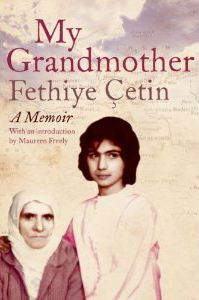
 My Grandmother’ by Fethiye Çetin (Verso, 2008, pp 144, 25TL)
‘Varsen Oruncakcıel: The Last Remaining Arapgirtsi’ interviewed by Mayda Saris (Birzamanlar Yayıncılık, 2011, pp 107, 25TL)
Fethiye Çetin grew up believing she was of “pure” Turkish stock, until one day her aging grandmother, Seher, took her aside and revealed that she had in fact been born an Armenian Christian, originally named Heranuş Gadaryan. Plucked from a death march as a young girl in 1915, Seher was raised as a Muslim by a Turkish gendarmerie commander and his wife, only to become aware of her true origins later in life. Some estimates suggest that there are hundreds of thousands of “hidden” or “Islamized” Armenians still living in Turkey, so this story may not be as unique as it may first seem. What is certainly remarkable, though, is that Çetin’s elegiac account of her grandmother’s story found a wide audience when it was published in Turkish in 2004, (going into its tenth print run in 2012).
The first section of “My Grandmother” offers gentle, sepia-tinged descriptions of Fethiye’s rural upbringing with her family in the eastern Turkish province of Elazığ: her beautiful sisters; her grandfather whose mood always depended on how full his stomach was; her grandmother, the charismatic matriarch of the family, powerful but taciturn, as if always harboring the secret that would one day be revealed to Fethiye. The central revelation in fact doesn’t come until midway through the book, but when it does Çetin writes that what she heard “did not fit with anything I knew. It turned the known world on its head, smashing my values into a thousand pieces.” Seher, or Heranuş, was one of the “kılıç artığı,” the “leftovers of the sword” of that traumatic period; only one of her sisters was also spared, while the rest of the family was killed off. The second part of the memoir consists of Çetin trying to digest the meaning of this heritage, and also trying to forge a reunion of the two sides of a family which now – like so many Armenian families – is “scattered like pomegranate seeds” across the world.

It’s a quietly powerful work, modest but courageous. There are no unnecessary fireworks or forced emotions. There’s little in the way of direct politics and no recriminations: I don’t think the word “genocide” is mentioned once in the entire book (and that’s not because of Turkish laws against these things). It’s simply a human story, told in a very humane, unshowy way.
An ostensibly similar, (though slightly less high profile), book is “The Last Remaining Arapgirtsi,” published in 2011 in the form of an extended interview with 95-year-old Varsen Oruncakcıel. Oruncakcıel was born in the village of Arapgir in the eastern province of Malatya, and was just one-year-old when the events of 1915 took place.
Over the course of the book, she gives simple, unembellished descriptions of both the difficulties and the joys of a long life spent between Arapgir, Malatya, and Istanbul. Family photographs are included, and while they show a lot of frowns and furrowed brows, they equally show a lot of smiling and celebrations. Although profoundly affected by the tragic shadow of 1915, Orancakcıel describes her life as being “colorful” – full of music, dancing and entertainment. Perhaps what is most striking about the book is this gentle confounding of the easy presumptions one might have about the nature of her story.
Neither of these books is concerned directly with the events of 1915, but it is their account of the effect on the “leftovers” that makes them interesting.