
The recent finding of fact in the Rachel Corrie case has once more thrown the spotlight on the Israeli policy of house destructions.
Nearly 10 years ago, the 23-year-old American activist was shot down by an Israeli ground forces while attempting to obstruct the demolition of a Palestinian home in the Gaza Strip.
Corrie and a group of activists from the International Solidarity Movement (ISM) were acting as human shields to attempt to cease the Israeli army destroying Palestinian homes and clearing land around the Palestinian town of Rafah.
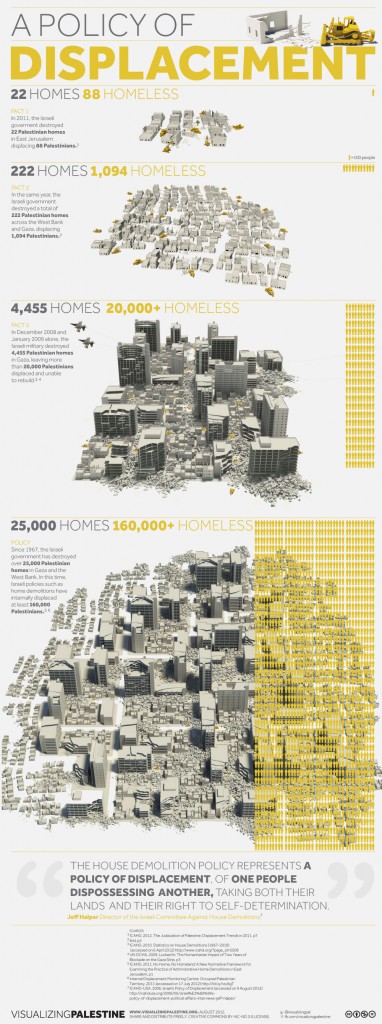
Since 1967, Israel has practised a range of policies conducting to the internal displacement of about 160,000 Palestinians inside the occupied West Bank and Gaza. Of these actions, home destructions are the most obvious.
These are executed by the Israeli army for a number of reasons, including “administrative” destructions, where Palestinian houses have been constructed without Israeli-issued permits, as well as punitive destructions – where a family member is charged of being involved in militant activity.
The most annihilating destructions, however, are made by large-scale operations, such as those during the war on Gaza in 2008-09.
Jeff Halper of the Israeli Committee Against House Demolitions (ICAHD) argues that, seen in their totality since 1967, these house destructions amount to an intentional “policy of displacement”.
Last year, ICAHD presented the UN with a report, accusing that Israel had a deliberate policy of forcing Palestinians out of East Jerusalem, and that this may constitute a war crime.
The mayor of Jerusalem, Nir Barkat, discharged the report.
ICAHD told 2011 was the record year of displacement , with the demolition of some 622 Palestinian structures by Israeli authorities, of which 222 were family houses. This led to 1,094 people being dislocated – almost double the number for 2010.