

What does Sayyid and Sharif mean?
The descendants of Imâm Hasan were called “Sharîf”, while those of Imâm Husayn were known as “Sayyid”. The Ottoman sultans showed unparalleled love and respect for the Sayyids and Sharîfs, unmatched anywhere else in the world. They took every measure to ensure these noble families lived in comfort and peace.
The term Ahl al-Bayt refers to all members of the Prophet Muhammad’s (peace be upon him) family. This includes his noble wives, his daughter Hadrat Fâtima, Imâm Ali, and their sons, Imâm Hasan and Imâm Husayn, along with their descendants until the end of time. Even the Hashimite clan, from which the Prophet’s pure lineage descends, is considered part of the Ahl al-Bayt. Additionally, Salman al-Farisi, one of the Prophet’s companions, was regarded as belonging to the Ahl al-Bayt. In a more specific sense, however, the term primarily refers to Imâm Ali, Hadrat Fâtima, and their two sons.
Who does the Prophet’s lineage continue from?
The Prophet’s lineage continued through Hadrat Fatima. To distinguish themselves and be shown due respect, the Sayyids and Sharîfs wore green turbans. The green turban of the Sayyids was known as the “Emir’s Turban.” Special officers, called Sâdât Sergeants, were appointed to verify that no one falsely claimed Sayyid status by wearing this turban. In addition, official Inspectors of the Sâdât investigated the authenticity of documents, known as hüccet, which served as certificates of Sayyid ancestry.
Sayyids enjoyed specific privileges. They were exempt from military service and taxation. Those in need received stipends from the state treasury, along with shares granted from war booty.
Unfortunately, very few academic studies have been conducted in our country on the institution of Naqib al-Ashraf and the honorable Sâdât. The first serious study was carried out by Prof. Dr. Murat Sarıcık, later published as “The Institution of Naqib al-Ashraf in the Ottoman Empire.” Dr. Ayhan Işık also prepared a doctoral dissertation titled “Sayyids and the Institution of Naqib al-Ashraf in the Light of Documents from the Şeyhülislamate Archives.”
The Importance of the Ahl al-Bayt
Several hadiths of the Prophet (peace be upon him) emphasize the importance of the Ahl al-Bayt:
“Whoever loves my Ahl al-Bayt, Allah will love him; and whoever harbors hatred against them, Allah will hate him.”
“The foundation of Islam is love for me and my Ahl al-Bayt.”
“Whoever follows the Book of Allah and my Ahl al-Bayt will be rightly guided, but whoever turns away will go astray.”
“My Ahl al-Bayt are like the Ark of Noah: whoever boards it will be saved, and whoever turns away will drown.”
The great scholar Sayyid Abdülhakim Arwâsî wrote in his treatise “The Companions of the Prophet” in Istanbul:
“The Prophet’s blessed daughter, Hadrat Fâtima, and her descendants until the Day of Judgment are all members of the Ahl al-Bayt. It is obligatory to love them, even if they should commit sins. Loving them means supporting them with heart, body, and wealth, showing respect, and upholding their rights. Such love ensures one dies with true faith.”
Turks Showed Great Respect to the Ahl al-Bayt
Throughout history, major Turkish states — including the Karakhanids, the Timurids, the Seljuks, and the Ottomans — displayed deep love and reverence for the Ahl al-Bayt. They provided every possible form of support.
In 1284, Seljuk Sultan Kayqubad III sent a mehter band and a standard to Osman Gazi, granting him the land of Söğüt. His imperial decree emphasized:
“Respect for the Sayyids is due to the fact that the Sâdât are the fruits of the tree of Prophethood, the pearls of the ocean of messengership, and one of the two precious trusts left to us by the Prophet. Honoring them is, in reality, an expression of reverence for the Messenger himself.”
Similarly, Ottoman sultans ensured the comfort and well-being of Sayyids and Sharîfs who visited their lands. For instance, a document in the Ottoman Archives records that when Sayyid Abdulwahid Efendi, a descendant of the Naqshbandi scholar Sayyid Amir Gilal of Bukhara, passed through Istanbul with twelve disciples on his way to Hajj, the Sultan instructed the Ministry of Finance to cover all their needs during their stay (BOA. Nr. 21101).
Naqib Al-Ashraf
The Ottoman State established the institution of Naqîb al-Ashrâf to serve the Sayyids and Sharîfs. The head of this institution (Naqîb) was always chosen from among the Sayyids and Sharîfs themselves. The Naqîb al-Ashrâf managed the affairs of the Prophet’s descendants, recorded their genealogies, entered their births and deaths into the registers, and prevented them from engaging in menial occupations or crafts unworthy of their noble lineage. He also safeguarded them from falling into disgrace, protected their rights, distributed their shares from the war booty, and prevented women of this lineage from marrying beneath their social standing. In this way, the Naqîb acted as the general guardian of the Prophet’s descendants.
The Sultans showed great favor to the Naqîbs in recognition of their valuable services. In the imperial decrees and certificates issued to them, expressions of reverence and respect appropriate to their rank and the nature of their duties were always used.
At the Şeyhülislamate Archives within the Istanbul Müftülük, a total of 39 registers of the Naqîb al-Ashrâf survive. These registers contain copies of siyâdat certificates (genealogical documents of Sayyid status) prepared for Sayyids and Sharîfs. To make the names of the Sayyids and Sharîfs easier to locate, the relevant entries were marked with red lines. Alongside these siyâdat certificates, the registers also include alphabetically arranged genealogical lineages of the Sayyids.
The first of these registers at the Istanbul Mufti Archives belonged to Naqîb al-Ashrâf Muhterem Efendi. Sayyid Muhterem Tashkandî, originally from Turkistan, is buried in Cağaloğlu near the Basilica Cistern.
Special Court for Sayyids and Sharîfs
In Hama, Syria, a court existed exclusively for Sayyids and Sharîfs. Descendants were officially registered, and false claims were prevented. Children of this lineage were recorded before a judge with two witnesses. This court was abolished during Sultan Abdülmecid’s reign by Mustafa Reşid Pasha, following British political interventions.
Why Zakât Was Not Given to Sayyids
Our Prophet declared that zakât was not to be given to the Sayyids. In Islam, zakât is considered the purification of wealth, and thus it was deemed inappropriate for this pure and noble lineage. According to Islamic law, spoils of war (ghanimah) were to be divided into five parts, with one-fifth allocated to the Ahl al-Bayt. However, contemporary Islamic scholars state that since Sayyids today no longer have such rights, they may receive zakât.
Ceremonies Attended by the Naqib Al-Ashraf
In the Ottoman state protocol, the Naqîb al-Ashrâfs always held the first position of honor. Some of the ceremonies in which the Naqîb al-Ashrâf was present alongside the Sultan included:
Sword Girding Ceremony:
The sword-girding ceremony for a newly enthroned Sultan was held in front of the tomb of Eyüp Sultan. The sword of Caliph ʿUmar, preserved in Topkapı Palace, was girded onto the new Sultan by the Naqîb al-Ashrâf.
Congratulation and Allegiance Ceremony:
During the enthronement (Cülûs) ceremonies of the Ottoman Sultans, the Naqîb al-Ashrâf was the first to offer prayers and pledge allegiance to the Sultan. Only afterwards did the members of the palace, in order of rank, begin their pledges.
Festival (Eid) Greetings:
At the palace festival gatherings, the Naqîb al-Ashrâf would stand to the left of the throne. At that moment, the Sultan would rise in respect. As the Naqîb al-Ashrâf advanced toward the Sultan, he would pray aloud: “May my Sultan live a thousand years with his state.” The Naqîbs attended such official ceremonies in their ceremonial attire. The official dress of the Istanbul Naqîb was identical to that of the Chief Military Judge (Kazasker). However, instead of the turban known as Örf, he wore a special headdress called Tepeli, wrapped with the green cloth reserved for Sayyids.
Bed’-i Besmele Ceremony:
When an Ottoman prince reached the age of five or six and was deemed ready for education, a tutor was appointed for him, and his lessons began with a special ceremony. This ceremony was called the Bed’-i Besmele. The Naqîb al-Ashrâfs were invited to attend this occasion.
Mawlid and Hirka-i Sharif Visits:
Each year in the month of Rabiʿ al-Awwal, on the occasion of celebrating the Prophet’s birthday, the Naqîb al-Ashrâfs would attend the Mawlid ceremony held at the Sultan Ahmed Mosque, upon receiving an official invitation letter from the Grand Vizier. During the Mawlid, the sweets and sherbet distributed to the participants were presented to the Naqîb al-Ashrâf on a separate tray, and special offerings of incense and rosewater were also made to him. At the conclusion of the ceremony, the Naqîb al-Ashrâfs would leave the mosque accompanied by their attendants and retinue. Each year during the month of Ramadan, the Naqîb al-Ashrâfs also took part in the visitation of the Holy Mantle (Hırka-i Şerif), again at the invitation of the Grand Vizier.
Imperial Campaigns (Sefer-i Hümayun):
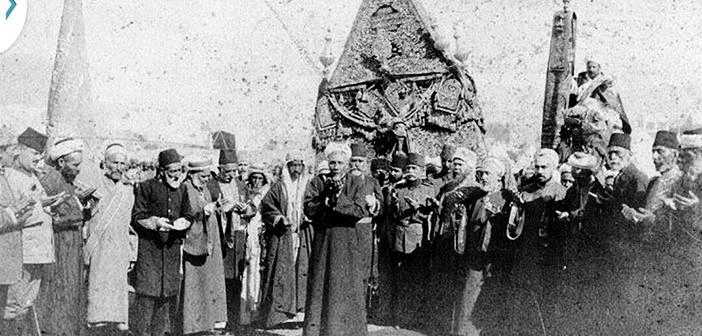
When the Ottoman sultans personally set out on campaign, the Sacred Standard of the Prophet (Sancak-ı Sharif), preserved among the Holy Relics, was taken from its place in the Chamber of the Holy Mantle (Hırka-i Sharif) and carried on the Sultan’s shoulder to the Audience Hall (Arz Odası), where it was leaned against the pillar of the Imperial Throne (Taht-ı Hümâyun). At that moment, the muezzins and Qur’an reciters recited the chapters of al-Fath and Yâ Sîn. Afterwards, the Grand Vizier, together with the Shaykh al-Islam, was summoned to the Audience Hall. The Sultan kissed the Sacred Standard, entrusted it to the Grand Vizier, and wished him success. As the Grand Vizier took the Standard upon his shoulder, the Shaykh al-Islam offered a prayer. The Grand Vizier then delivered the Standard to the Alemdar, the highest-ranking commander among the Sayyids after the Naqîb al-Ashrâf. Mounting his horse outside the Middle Gate, the Procession of the Sacred Standard began, accompanied by Sayyids, Sharîfs, and the Naqîb al-Ashrâf chanting takbîrs and salawât.
When the sultans themselves joined the campaigns, a number of Sayyids under the command of the Naqîb al-Ashrâf also took part. The Sacred Standard was taken to the battlefield for the first time in 1597, during the Campaign of Egri, accompanied by about 300 Sayyids and Sharîfs.
What Happened to the Institution of Naqib al-Ashraf ?
Prof. Dr. Murat Sarıcık explains:
“Although no surviving document records the abolition of the Naqîb institution, it is clear it ended with the abolition of the sultanate.”
——-