

Introduction
The Soviet Union, having secluded itself behind the Iron Curtain, resembled a laboratory: its territory an entire country, its technician the single ruling party, and the results of its experiments preserved as closely guarded state secrets. But what, one may ask, was the subject of this experiment? Could the theory of communism, drawn from the very heart of Marx’s thought, truly and comprehensively meet the needs of social life?
To seek an answer to this question, in 1978 a Turkish intellectual, Mustafa Necati Sepetçioğlu, together with his wife, traveled to the Soviet Union for a stay of thirty-three days.
At that time, it was nearly impossible to visit the Soviet Union as an independent tourist. The reason for this was the reality of Intourist. Intourist, a state-controlled tourism agency (like all other enterprises in the Soviet Union), was responsible for arranging the itineraries of foreign visitors. It allowed them to see only what the state intended to display, and only within the time frame determined by the authorities. The places one personally wished to visit were of no consequence.
In order to implement this system effectively, the company brought tourists into the country in organized groups. Yet the Sepetçioğlu couple refused to join such a group, determined instead to see the realities of the Soviet Union. Although Intourist delayed their request for a long time, it eventually consented, and thus, in 1978, they traveled there. For thirty-three days, Sepetçioğlu observed various aspects of social life, recording both what he personally witnessed and what he heard from others whose testimony he deemed reliable. The resulting work is valuable insofar as it provides significant insights into the Soviet Union, since every concrete incident he describes regarding social life illustrates the manifestations of communism as the official state ideology. To understand the governance of the Soviet state, its characteristic features, and the condition of the Russian people under its administration—in short, the very nature and temperament of Soviet Russia—one must carefully reflect upon Sepetçioğlu’s memoirs.
Economic Realities of Soviet Communism
One of communism’s greatest promises was economic equality. And indeed, in this respect, everyone was equal—but equal only in their destitution. The state went further still, constructing an economic system designed to perpetuate impoverishment. Three mechanisms in particular stood out: the black market, the miscalculations of the central planner, and exploitative rental practices in hotels.
The Black Market
Communist officials claimed that in the Soviet Union there were no institutions associated with bourgeois immorality—such as brothels or prostitution. Yet establishments known as “Beriozka” or “Souvenir Shops”—terms that softened their true nature—did exist. These establishments differed from ordinary shops in that they offered products (such as silk stockings, lipstick, or kohl for women) and services (such as mixed-gender entertainment in drinking and dancing venues) which Soviet citizens could not purchase with their own currency, but which were made available to foreign tourists in exchange for dollars. Naturally, Russian men and women also desired access to these goods and services, and in order to obtain dollars they were often willing to pay several times more than their actual value.
But was this not a black market? And was this not, likewise, a form of bourgeois immorality?
Through such establishments, the state itself created a black market for basic consumer goods, collecting whatever foreign currency the people possessed, while simultaneously impoverishing them further.
Central Planning and its Miscalculations
One of the economic realities of the Soviet Union was the role of the central planners. A central planner was the official responsible for determining how much each factory would produce. His calculations were such that, to those reviewing the plans, human beings were treated as if they were inexhaustible machines, and his figures appeared as immutable as the laws of physics.
In factories subject to these plans, workers produced goods of genuinely good quality during the first ten days of the month. Yet in the remaining days, production continued merely to meet quotas, and quality declined accordingly. Indeed, fluctuations in the supply of goods in shops could be observed in relation to these time-bound patterns of production and demand.
The central planner did not calculate only the production of goods. He also determined the wages of workers and retirees. Because he regarded people virtually as machines, wages were calculated and distributed at a level sufficient only to cover the most minimal of human needs.
Exploitative Hotel Practices
The state also exploited tourists through the rental practices in hotels. When Sepetçioğlu and his wife first arrived at the famous Rossiya Hotel, they were genuinely impressed by its grandeur. Yet despite the bitter cold, the hotel’s heating system was not functioning. When they asked for a samovar and two cups in order to keep warm, they were charged rental prices amounting to exploitative extortion. In other countries at the time, such basic services were provided free of charge in hotels. But in the Soviet Union, nothing was given without cost—there was only taking without giving.
As the so-called “salon communists” claimed, there was indeed economic equality in the Soviet Union—but no prosperity. It was as if one had to assume the opposite of whatever was said about Soviet Russia.
Social Realities under Soviet Communism
Alongside these economic realities, there were also social realities that affected every community and nation living under the Soviet state. These may be examined under four headings: propaganda, gratuities, surveillance, and state authority.
Propaganda and Cultural Subordination
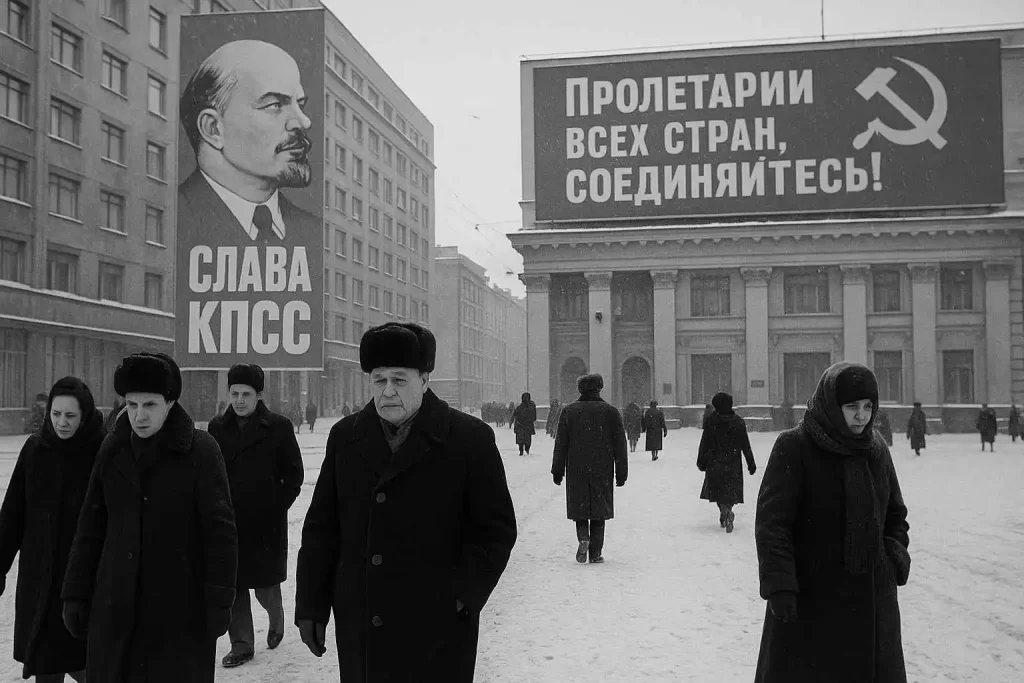
Propaganda in the Soviet Union manifested itself as sheer hypocrisy. To foreign audiences, officials boasted incessantly of their commitment to freedom and of their great strength. Since all media channels were under state control, the Soviet Union always appeared far greater than it truly was. Newspapers, journals, billboards, and every other medium of communication had become servants of ideology. And it did not end there: art itself was subordinated to ideology. No work published in the Soviet Union could be anti-communist or sympathetic to imperialism. Thus, the literature that had once been the pride of the world during Tsarist Russia had, under communism, regressed by what seemed like centuries.
Nor was propaganda confined to the outside world; it was also directed inward to convince the population of the state’s supposed strength. For example, the Cosmos Pavilion was a festival, open at certain times of the year, where Soviet technological achievements were displayed. Advanced technologies such as spacecraft, tanks, weapons, and rockets were exhibited there. At this festival, the public was even able to eat meals they could never normally afford in restaurants, even if they paid. For this reason, the Cosmos Pavilion may have been the only place where the Russian people felt some satisfaction with their state, for there they witnessed evidence—at least seemingly—that the state was functioning and not simply plundering.
But was that really the case? To answer in the affirmative would be illogical. For if a state that spent vast sums on propaganda truly possessed genuine scientific capacity and capable scientists—the real sources of power—would it need to rely so heavily on propaganda at all? Is propaganda not, by definition, a weapon used to portray the exact opposite of reality? Why else should products requiring the highest levels of engineering science be reduced to mere instruments of propaganda? The very fact that these technological marvels were displayed in such a manner stands as strong evidence that they were the result of technological appropriation through industrial espionage.
Gratuities as Institutionalized Bribery
In the Soviet Union, tipping functioned as bribery. Sepetçioğlu recounts how the guide who accompanied them on their tour demanded extra money under the guise of a “tip.” Similarly, he tells of paying three rubles for a taxi fare that should have cost only fifty kopeks. In restaurants, forgetting to collect one’s change after paying the bill was almost a social obligation, since the withheld amount was considered a voluntary (!) gratuity for the “excellent service” provided. In the Soviet Union, bribery disguised as tipping had become normalized as a moral convention: one who refused to give a bribe was branded immoral and inevitably ostracized within society.
Surveillance and Paranoia
Control mechanisms in the Soviet Union revealed themselves as paranoia and excessive suspicion. For instance, when Sepetçioğlu arrived at Moscow Airport, he was puzzled to see two police officers stationed at every checkpoint. Later, he learned that the second officer was assigned to supervise the first, meaning that the state appointed an inspector for every inspector.
Moreover, in a state that claimed to be a global superpower, the proportion of people who spoke a foreign language was strikingly low. This, too, was a consequence of the state’s control mechanisms. The government regarded the acquisition of foreign languages as dangerous, since it also introduced citizens to foreign cultures. Exposure to such cultures, with their promises of freedom, would inevitably appear more appealing, and the state feared it would thereby lose its authority over its citizens.
Russian citizens would never utter a word against communism or the state—not even in a whisper—while in public places. Nor would they speak such things at home. If such a subject had to be raised, they would go outside and converse only by a riverbank, since people believed that their homes were under surveillance. Certain events Sepetçioğlu both personally experienced and heard from others lend credence to this belief. Taken together, these accounts reveal the state’s pathological obsession with control mechanisms.
State Authority as a Pseudo-Divine Order
The state elevated its will to the status of a divine ordinance. Whatever the state willed was how the people were to be governed. Cloaking themselves in divinity, the heads of state abolished all religious education and closed every sacred site across the Soviet Union and within the five Turkic republics under its rule. By such means, they sought to compel worship of themselves and instill the belief that they were gods. One of the most horrifying pieces of evidence for this is the incident described in the book under the title “The Waiting Children.”
An institution (namely, the state) that believed in the perfection of its ideology and sought to impose it upon society ought to have produced perfect outcomes. Yet the results could be observed even in the restaurants of the Rossiya Hotel. If one arrived late for mealtime, the food, having been placed on the table at the designated hour, was almost certainly cold. Everything had to be perfectly regulated. Even ordering an extra dish exposed the restaurant staff’s utter inability to cope. Another example was the allocation of state resources, which was so minutely calculated that the damage from a potential fire could be repaired only after several years.
In his book, Sepetçioğlu remarks: “Life in (Soviet) Russia is a discipline of directives.” For whatever the state deemed good was good, and whatever it deemed bad was bad. For every human necessity—sleep, work, shopping—the state determined how much time was appropriate. Human beings’ natural needs and desires were of no consequence whatsoever.
The atmosphere of communism breathed in the Soviet Union
Thus was the atmosphere of communism breathed in the Soviet Union, as described above. When we consider the events Sepetçioğlu both witnessed and personally experienced, is not the answer to the question posed at the very beginning of this essay already clear? Has the theory of communism, in practice, been able to meet the needs of social life?
This study suggests that the Soviet experiment, while claiming to establish equality, institutionalized poverty, coercion, and ideological domination. Whether communism in practice ever fulfilled the needs of social life remains doubtful; at the very least, Sepetçioğlu’s observations provide compelling evidence to the contrary.
For the discerning intellect, even a single sign may suffice.