

U.S. President Donald Trump has outlined a controversial plan for Gaza, suggesting that Palestinians be relocated to neighboring countries while the United States assumes control over the region. Trump stated, “We are in no rush,” emphasizing that the plan would unfold gradually. He added that the U.S. would act as an “investor,” while Israel would be responsible for security, ensuring that American troops would not be needed on the ground.
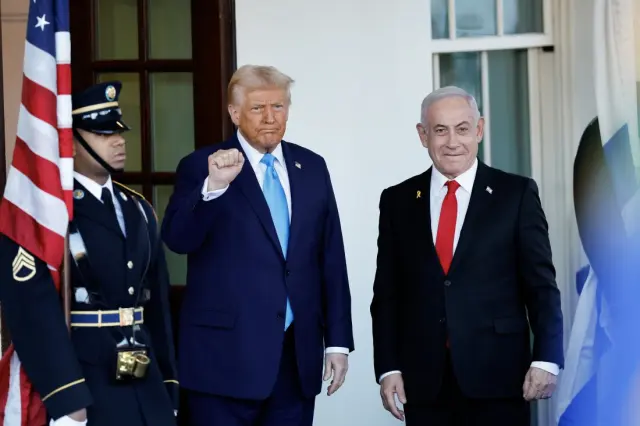
Trump: ‘No Rush on Gaza Issue’
Speaking at the White House alongside Japanese Prime Minister Ishiba Shigeru, Trump addressed questions regarding the possible relocation of Gaza’s Palestinian population to countries like Egypt and Jordan. He dismissed the urgency of the situation, saying, “There are no ongoing negotiations on this issue right now. However, we will not rush into anything. This has been going on for over 50 years. We just want stability, but we are in no rush.”
Trump’s remarks suggest that his administration sees the Gaza issue as a long-term geopolitical matter rather than an immediate crisis. His comments also reflect a broader U.S. strategy of economic involvement rather than direct military intervention.
“We Will Invest, Israel Will Handle Security”
Trump reiterated that the U.S. would focus on economic investments in Gaza rather than military involvement. He expressed concerns about Palestinians returning to Gaza only to leave again in the future. “We will be an investor there,” he said. “But security will be handled by Israel. We have no need to send troops.”
While positioning the plan as a way to bring stability and economic growth to Gaza, Trump’s remarks align with his administration’s pro-Israel stance, which has repeatedly sidelined Palestinian sovereignty. The idea of U.S. investment without Palestinian self-determination raises questions about the region’s future governance and autonomy.
Trump’s Gaza ‘Takeover’ and Forced Displacement Plan
During a joint press conference with Israeli Prime Minister Benjamin Netanyahu, Trump previously stated that the U.S. would assume control over Gaza and be responsible for clearing unexploded bombs, dismantling weapons, and removing debris from destroyed buildings.
Describing Gaza as a “completely devastated area of destruction,” Trump suggested that Palestinians should relocate to newly built settlements in neighboring Egypt and Jordan. “It would be much better for them to move,” he claimed. “The U.S. will take over Gaza, and we will do business there. We will take control and handle the removal of all dangerous explosives and debris from the area.”
Global Reactions and Controversy
Trump’s remarks have sparked significant debate, with critics arguing that his plan ignores Palestinian rights and sovereignty. The idea of forcibly relocating Palestinians has been widely condemned by international organizations and Middle Eastern governments, who see it as a violation of fundamental human rights.
Moreover, the proposal raises geopolitical concerns about how Egypt and Jordan might respond to an influx of displaced Palestinians. Both countries have historically played key roles in regional peace efforts, but neither has expressed willingness to absorb large numbers of Palestinian refugees.
The Trump administration’s approach to the Israeli-Palestinian conflict has been consistently pro-Israel, leading to escalating tensions in the region. While Trump frames his vision for Gaza as a step toward stability, critics argue that it is a unilateral move that disregards Palestinian aspirations for self-determination.
What’s Next for Gaza?
As the situation unfolds, many questions remain unanswered. Will neighboring countries accept displaced Palestinians? What role will the international community play in shaping Gaza’s future? And most importantly, how will Palestinians respond to a plan that threatens their homeland?
One thing is clear: Trump’s proposal, if pursued, would significantly reshape the geopolitical landscape of the Middle East, with lasting consequences for both Palestinians and the broader region.