Once, Turkestan where states and magnificent civilizations such as the Karakhanids, Ghaznavids, Seljuks, and Timurids had been founded, and where thousands of scholars and saints had been raised, experienced great disasters and tragedies starting from the second half of the 19th century. All of Turkestan was occupied by the Russians. Turkish history, culture, and civilization were destroyed. The last great disaster was experienced during World War II…
In 1941, war broke out between Hitler’s Germany and Stalin’s Soviet Russia. Several million Turkestanis were drafted. Most died or were captured during the war. Very few were able to return home. Regarding this, former President of Uzbekistan Islam Karimov states: “During the Second World War, one and a half million young people, about 22% of Uzbekistan’s population, were conscripted and sent to various fronts. After the war, only about 60,000 of them were able to return to their country”. Former President of Turkmenistan Saparmurat Atayevich Niyazov likewise states that 740,000 Turkmen youths were conscripted during World War II, almost all of whom died on various fronts, with thousands left disabled.
Dr. Boymirza Hayit, a great intellectual and political figure of Uzbekistan, who was conscripted during World War II, given the rank of lieutenant, participated in the war, and became a prisoner of war, has very valuable articles and books on this subject. Dr. Boymirza Hayit records the following: “In the early years of the war that began between Germany and the Soviet Union in June 1941 (1941–1943), there were about 5 million Turkestanis in the Red Army. According to information provided by the German War Offices, nearly 2 million Turkestani soldiers were present on the Soviet western front in the early years of the war. According to information given in 1943 by the German Prisoner of War Headquarters located in the city of Torgau, nearly 1.7 million Turkestani soldiers were captured by the Germans in the early years of the war. When the war began, all Turkestanis between the ages of 18 and 65 were sent to the front. The majority of those conscripted were secondary and higher-education students or primary and middle-school teachers. Among them were also engineers, doctors, and craftsmen.
The soldiers lacked clothing suitable for the climate. Furthermore, Russian commanders did not give Turkestani soldiers good weapons. Most carried pieces of wood resembling rifles. The Germans dealt a heavy blow to the Turkestanis positioned at the front lines. As a result, some Turkestanis were killed, and most surrendered to or sought refuge with the Germans. The majority of Turkestani soldiers did not know Russian. For this reason, they were treated as second-class soldiers. Every Turkestani Soviet soldier also had the question in his mind: ‘Why am I here, in this faraway land?’”
THE NATIONAL TURKESTAN UNITY COMMITTEE IS FORMED
Among the hundreds of thousands of Turkestanis captured by the Germans during World War II, the educated doctors, teachers, and officer came together to form the “National Turkestan Unity Committee.” One of the members, Zuhriddin Mirza Abid, explains their founding purpose as follows:
“The sole aim of the National Turkestan Unity Committee was to meet the needs of captured Turkestanis and to ensure that their homeland, Turkestan, would gain freedom and independence, so that the people might be saved from slavery and oppression. The leaders of this movement were Mustafa Shokay and Veli Kayyum Han. Mustafa Shokay visited prisoners of war camps and negotiated with German state officials to rescue thousands of captured Turkestanis. When he saw the miserable condition of the prisoners in the camps, he would say: ‘I would rather die than see them like this.’”
“The death rate in the camps was very high.”
Indeed, this terrible situation in the camps was recorded in official reports as well. In the official report of Camp No. 318 in Lamsdorf, located in southwestern Poland, belonging to the German Armed Forces:
“From the end of July 1941, prisoners of war were digging into the ground to search for food. In the first weeks, prisoners were seen eating grass, tree bark, and raw potatoes like animals. Since they could find nothing to eat on the land, they even began eating human flesh from the dead!..”
The death rate in the camps was very high. No international organization could reach these prisoners. Veli Kayyum Han described the human tragedy in the camps in many reports he wrote.
Mustafa Shokay worked tirelessly to save captured Turkestanis. He frequently visited those camps. In December 1941, he contracted typhus, which was widespread among the prisoners, and passed away. His funeral was held in the Muslim cemetery in Berlin. His death caused great sorrow among the Turkestanis.
THE NATIONAL TURKESTAN ARMY IS FORMED
Member of the National Turkestan Committee Zuhriddin Mirza Abid states the following about the formation of the National Army:
“After Mustafa Shokay’s death, the Turkestani prisoners in Germany showed great devotion to Veli Kayyum Han. They began addressing him as ‘Ata’ (Father). The prisoners cheered him with these words: ‘You are our father! You saved us. Through Allah’s will, you granted us life. Now we are ready to fight voluntarily with the National Army, with the National flag, under the slogan “Allah is with us,” against our real enemy, Soviet imperialism, and to liberate our country.’
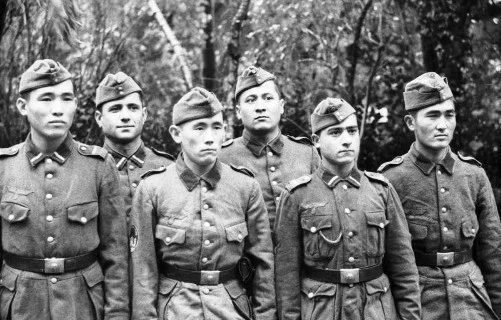
Thus, the idea of forming a ‘National Army’ from the hundreds of thousands of Turkestani soldiers in the camps emerged. They were told that their true enemy was the Russian imperialist power that exploited their homeland. Turkestani intellectuals and teachers taught the prisoners about our history, our great ancestors, and our religion. They emphasized the importance of Turkestan gaining its freedom. Thus, from among the captured Turkestani soldiers, the National Turkestan Army began to take shape.
The main purpose of the Turkestan National Army was, this time, to fight Russia alongside the Germans and to liberate their homeland from captivity.
‘Allah is with us.’
The National Turkestan Army had approximately 180,000 soldiers. The soldiers wore armbands on their right arms that read ‘Allah is with us.’ The oath ceremony was performed under the Turkish-Islamic flag, with hands placed on the Qur’an and two swords. The poem “O Beautiful Fergana!” by Uzbek poet Abdulhamid Sulaymon Choʻlpon became their national anthem. In August 1942, the “National Turkestan Journal” began publication under the leadership of Veli Kayyum Han.
The National Turkestan Army fought the Red Army for the first time on May 2, 1942, in the Bryansk forests. Various successes were achieved in the battles. The Russians would immediately shoot the soldiers they captured from the Turkestan Legion, calling them “black fascists.”
World War II ended
With Germany’s defeat, World War II ended. Unfortunately, the National Turkestan Army was disbanded. The Turkestani soldiers were left without protection. Veli Kayyum Han was also taken prisoner. Under the decisions of the Allies’ Nuremberg trials, some German commanders were sentenced to death and others to life imprisonment. Among them, Veli Kayyum Han defended himself as follows:
‘If I cooperated with the Germans, it was for my homeland, Turkestan. My country has long been crushed under the cruel oppression of the Soviets. The independence of my country could only be achieved through the defeat of the Soviets. Therefore, I undertook this work with pure intentions. I am not a fascist, because I oppressed no one. I am only someone who fights for the freedom of his homeland. We took part only on the Eastern Front. We were not on the Western Front…’
Three of the prosecutors, those from the United States, England, and France, accepted this defense, but the Soviet prosecutor demanded that Veli Kayyum Han be handed over to them and executed. However, the other prosecutors did not accept this request and sent him to prisons controlled by the Western Allies. Veli Kayyum Han was released from prison in 1947 and resumed his committee activities, beginning publication of the “National Turkestan Magazine”. He passed away on 15 August 1993 in Düsseldorf. He was buried in the Muslim cemetery with a very large funeral ceremony.
THE YALTA AGREEMENT AND THE TRAGIC END
When the Germans were defeated and World War II ended, more than 70,000 Turkestani soldiers were in the hands of the British and Americans. The Allied states, the United States, Britain, and the Soviet Union, met in Yalta in February 1945 and reached an agreement. According to this, each state would reclaim its citizens who had been captured during the war. This decision was pleasing for Western war prisoners, but for those captured from the Soviet Union, it was nothing short of a death sentence.
Dr. Boymirza Hayit prepared a list of nearly 105,000 Turkestani war prisoners and sent it to the Turkish General Staff via a courier from Tehran. A commission convened in Ankara on the matter and reached the following decision:
“If these prisoners are brought to Turkey, more than 10,000 of them are spies. How will we later rid ourselves of such a situation? For this reason, the Turkestani prisoners in Germany cannot be accepted into Turkey.”
According to the Yalta Agreement, the Turkestani war prisoners held by the armies of the United States, Britain, and France were forcibly handed over to the Soviet Union. More than 200,000 prisoners, including those from Turkestan and other nations who had formed their own legions in Germany and fought against the Red Army, resisted returning to the Soviet Union. The Russians executed some of the soldiers they took into custody, and sent others into exile in Siberia or other distant labor camps. Hearing that the Russians were executing those they captured, some soldiers chose to commit suicide rather than surrender.
THE SUFFERING CONTINUES
After the war, those from Crimea, the Caucasus, and the Meskhetian regions who remained on the Russian side or returned home found an even more tragic scene. When they reached their homes, they found none of their family members. The Russians had deported hundreds of thousands of people from these regions, loading them into cattle wagons and sending them to the remotest corners of Central Asia. Half of them died on the way. Of those who survived, many perished due to climate change, disease, and hunger.
Unfortunately, as Prof. Dr. İbrahim Şahin says: “The Second World War was a war in which the Turks outside Turkey participated entirely and were affected by its consequences more than anyone else. Yet in no documentary, book, novel, story, poem, play, or film prepared about this war between 1938 and 1945 is there any mention of the Turks’ participation in it or of what they experienced during it!”
Today, near the city of Liège in Belgium, there is a large American Cemetery. All American soldiers who died in the Second World War are buried there. A well-maintained monument stands in this cemetery, containing all information about the war and the fallen soldiers, their hometowns and units. Sadly, the hundreds of thousands of Turkestani soldiers who lost their lives on the German side in World War II have neither a gravestone nor a monument, nor is the Turkish youth aware of these tragedies…