

Turkey’s pivotal role in Europe’s energy security
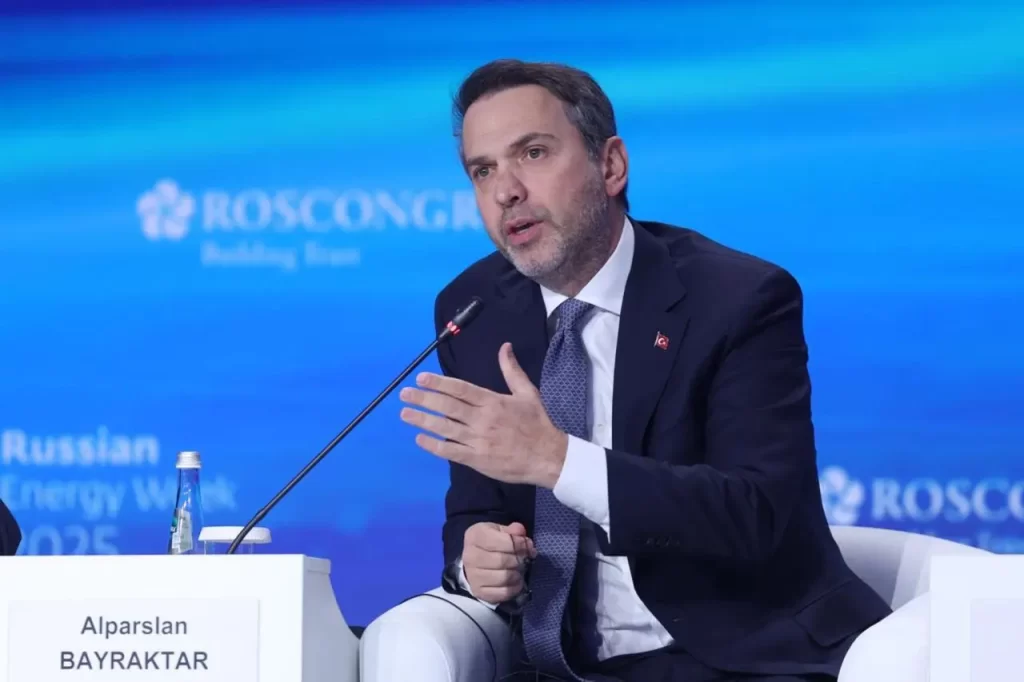
Turkey has emerged as a cornerstone of Europe’s energy stability, said Energy and Natural Resources Minister Alparslan Bayraktar at the Global Energy Markets Forum in Moscow. Through the Trans-Anatolian Natural Gas Pipeline (TANAP) and TurkStream, Turkey connects producers in the Caspian and Russia with consumers stretching to Italy.
Bayraktar called for a stronger partnership between Ankara and European capitals, urging them to expand cross-border infrastructure not only for oil and gas but also for electricity. “Real progress requires political will and shared determination,” he noted.
TANAP and TurkStream strengthen regional supply routes
TANAP currently carries 16.2 billion cubic meters (bcm) of Azerbaijani gas each year, of which 5.7 bcm stays in Turkey while the rest flows to Greece and Italy. TurkStream, which runs beneath the Black Sea to Turkey and onward to Southern Europe, delivered nearly 10 bcm in the first half of 2025.
Bayraktar described Turkey’s approach as the “Turkish Way” — a pragmatic and flexible energy policy designed to balance domestic demand, reduce import dependency, and advance carbon neutrality by mid-century. “Our goal is clear: meet growing energy needs, lessen external reliance, and move toward a carbon-neutral future,” he said.
Renewables and nuclear form the twin pillars of power expansion
Turkey expects its electricity demand to triple over the next three decades. To meet this surge, the government plans to add 8–9 gigawatts (GW) of renewable capacity annually, targeting 120 GW by 2035. Solar and wind will lead this growth, backed by local equipment manufacturing and modernized grids.
At the same time, the Akkuyu Nuclear Power Plant — developed with Russia’s Rosatom — will supply 4.8 GW once all four reactors come online. The first unit is scheduled to start operations in 2026, marking a milestone in Turkey’s low-carbon transition.
Bayraktar said the long-term plan includes building 12 large-scale reactors and 5 GW of small modular reactors (SMRs). “We aim for balance,” he emphasized. “Renewables at the core, nuclear for stability.”
The ‘Turkish blend’ and diversified gas strategy
Turkey’s energy map extends beyond its borders — from Pakistan to Libya, Somalia, Iraq, and the Caspian region. It imports liquefied natural gas (LNG) mainly from North America, Mozambique, Australia, and Russia, while boosting domestic exploration in the Black Sea, where production could reach 16 bcm by 2028.
Since 2016, Turkey has expanded its LNG regasification capacity from 32 million to 161 million cubic meters per day, enabling flexible sourcing from multiple regions. This infrastructure underpins the “Turkish blend” model — mixing gas from various suppliers before distribution.
“LNG brings flexibility and competition,” Bayraktar said. “With diverse supplies, we can deliver more affordable gas at home and to our neighbors.”
A balanced and forward-looking path
By integrating renewable energy, nuclear power, and multi-source gas, Turkey is shaping itself as a regional energy hub — not only a transit state but an active market maker. As Bayraktar’s remarks in Moscow show, Ankara’s “Turkish Way” aims to ensure energy security, affordability, and sustainability across borders.