

Understanding the Root Causes of Turkish-Greek Tensions
The longstanding disputes between Turkey and Greece over the Aegean Sea have deep historical roots and complex geopolitical dimensions. From territorial waters to airspace boundaries, both nations have found themselves at odds in a region that holds significant strategic and economic importance. This article explores the root causes behind Turkish Greek tensions, examines recent developments, and evaluates the potential for a peaceful resolution.
Historical Background: A Legacy of Disputes
The tensions between Turkey and Greece in the Aegean Sea are partly a product of their intertwined histories. Since the 19th century, both nations have experienced multiple conflicts and territorial reconfigurations, which have fostered mutual suspicions. The Treaty of Lausanne (1923) and later the Treaty of Paris (1947) established the current boundaries, but ambiguities within these agreements have led to differing interpretations. For Turkey, certain Greek islands located just off its coastline are seen as strategically critical, while Greece insists on its sovereignty over these territories.
Recomended Article: The Abolition of the Caliphate: A Missed Opportunity for Global Stability
Key Issues in the Dispute
The Turkish Greek rivalry in the Aegean revolves around three primary issues:
- Territorial Waters: Greece claims a right to extend its territorial waters from 6 to 12 nautical miles, as allowed under international law. Turkey, however, views this as an infringement on its access to international waters and has stated it would consider such a move a cause for war.
- Airspace and FIR (Flight Information Region): Greece claims a 10-mile national airspace limit around its islands, while Turkey recognizes only a 6-mile limit, consistent with the existing territorial water boundary. This disparity has led to frequent confrontations between Turkish and Greek aircraft.
- Continental Shelf and Exclusive Economic Zones (EEZ): The exploration of hydrocarbon resources in the Aegean Sea has intensified the dispute. Both Turkey and Greece seek to establish their rights to the seabed, which is believed to be rich in oil and gas reserves, yet the boundary definitions are highly contentious.
Geopolitical Dimensions: Beyond Bilateral Relations
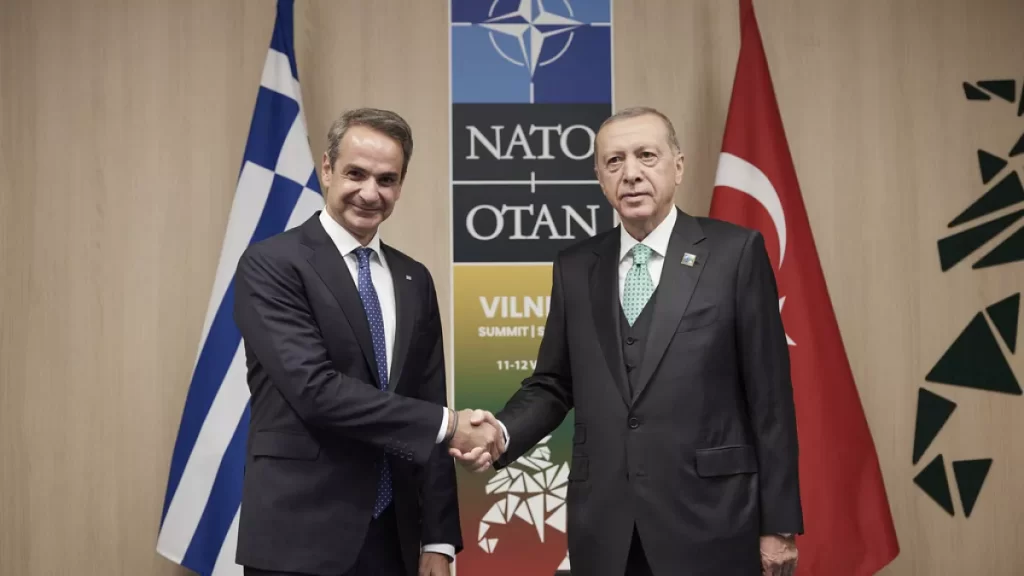
The Turkish Greek tensions in the Aegean Sea have attracted the attention of other countries and international organizations, further complicating the path to resolution. Greece, as a member of the European Union, often seeks support from EU countries, framing the issue as a matter of European security. Turkey, while a NATO member, faces unique challenges as it balances its regional aspirations with its alliances.
The Role of NATO and the EU
The involvement of NATO and the European Union in Turkish Greek disputes reflects the broader security and stability concerns in the Eastern Mediterranean. NATO has attempted to mediate by establishing deconfliction mechanisms, but the mutual distrust between Greece and Turkey remains a major barrier. Meanwhile, the EU has supported Greece’s position, leading Turkey to question the EU’s impartiality in regional disputes.
Energy Politics: The Search for Resources
With the discovery of potential gas reserves in the Eastern Mediterranean, energy resources have become a focal point in the Aegean tensions. Both Turkey and Greece are eager to establish Exclusive Economic Zones (EEZs) to secure rights over these resources. For Turkey, energy independence is a priority, given its high reliance on foreign energy imports. For Greece, energy resources represent economic potential and an opportunity to strengthen its influence in the EU.
Is a Resolution Possible?
Achieving a resolution to Turkish Greek tensions in the Aegean is challenging but not impossible. Both nations have, at times, shown a willingness to engage in diplomatic talks, although these efforts have often been overshadowed by renewed confrontations. The path to resolution likely involves a combination of negotiation, third-party mediation, and mutual concessions.
Recent Diplomatic Initiatives
In recent years, Turkey and Greece have engaged in exploratory talks to address their differences, with support from NATO and the EU. While these discussions indicate a positive shift, each side remains cautious about conceding on core issues, especially in relation to territorial rights and energy exploration.
Confidence-Building Measures
Building trust is essential for any long-term resolution. Confidence-building measures, such as joint patrols in disputed waters and transparent communication channels, could reduce the risk of accidental confrontations. These steps, if successful, might create an environment where more substantive negotiations can occur.
Legal Arbitration: An Uncertain Solution
One possible avenue for resolving the Aegean Sea disputes is through legal arbitration, such as taking the case to the International Court of Justice (ICJ). However, for this approach to work, both Turkey and Greece would need to agree on the terms of arbitration. While Greece has shown interest in this option, Turkey remains hesitant, questioning whether the ICJ would fairly address its concerns regarding regional security and strategic access.
Moving Forward: The Prospects of Peace
The road to peace between Turkey and Greece is complex, requiring not only political will but also a shared vision of security and cooperation in the Aegean. While the current outlook may appear tense, history shows that sustained diplomatic efforts and international support can help nations navigate disputes peacefully. For Turkey and Greece, fostering a relationship based on mutual respect and shared interests in regional stability may be the key to moving beyond a history of discord.
Recomended Article: Exposing the Western Double Standards and Media Games