One of the most important phases of Islamic history is the Turks’ acceptance of Islam. Hadrat Seyyid Abdülhakim Arvâsi stated, “After the Companions of the Prophet, the Ottomans have rendered the greatest service to Islam.” After becoming Muslims, the Turks became the pioneers of Islam. They established great Islamic states such as the Karakhanids, Ghaznavids, Seljuks, Ottomans, and Mughals. They spread Islam to all of Central Asia, Russia, India, the Balkans-Rumelia, and the Caucasus.
The Russian Federation has an area of approximately 17000 km² and a population of about 145 million. Russia is both a neighboring country and one where very large Muslim communities live in various regions. It is an observer member of the Organization of Islamic Cooperation. Another important point is that the Muslim population is constantly increasing, while the Christian population is decreasing. The majority of Muslim Turks in Russia are located in the Volga-Ural, Moscow-St. Petersburg, and Crimea-Caucasus regions. Today, there are highly positive developments between Russia and Turkiye in terms of politics, trade, and tourism, to the benefit of both countries. Following the collapse of the Soviet Union, Muslims in Russia can travel anywhere in the world, primarily to Turkiye. Many people from Turkiye also travel to Russia to meet relatives they could never see during the Soviet era, re-establishing family ties.
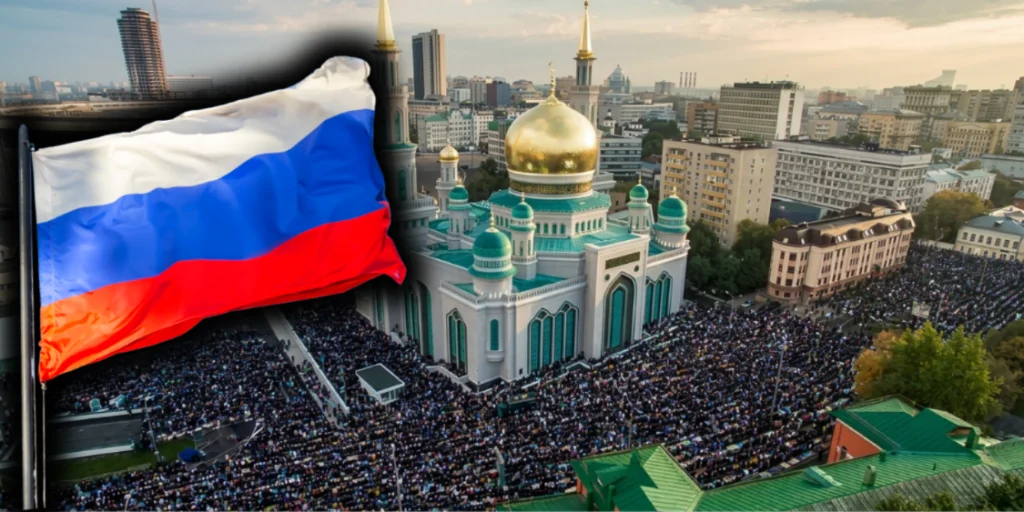
Russia’s largest mosque, the Moscow Cathedral Mosque, was built with major contributions from the Turkiye Diyanet Foundation. The mosque was inaugurated jointly by President Recep Tayyip Erdoğan and Russian President Vladimir Putin. During a meeting with muftis in the city of Ufa, Bashkortostan, on the occasion of the anniversary of the establishment of the Central Spiritual Administration of Muslims of Russia, Putin stated:
“Islam is an inseparable part of Russia’s spiritual life.” Because of Putin’s positive view of Islam, Muslims also harbor sympathy for him. Muslims in Russia are highly pleased with the growing relations between Turkiye and Russia, and they closely follow developments in Turkiye. Since the dissolution of the Soviets, Turkiye’s Presidency of Religious Affairs (Diyanet) has been sending imams to many mosques in Russia. Additionally, the Turkiye Diyanet Foundation is establishing an Islamic University in Ufa, the capital of Bashkortostan. On December 3, 2018, İhlas Foundation Chief Advisor Prof. Dr. Ramazan Ayvallı also gave a conference in Ufa about the Hadrat Muhammed Murad-ı Kazâni.
The First Muslim Turkic State: The Volga-Bulgar Khanate
Regarding the establishment of the first Muslim Turkic state, Prof. Dr. Ahmet Şimşirgil notes the following:
“Until today, it was accepted that the first Muslim Turkic State was the Karakhanids and the first Muslim Turkic Ruler was Abdulkerim Satuk Bughra Khan. According to recent examinations and research, the Bulgar Khanate—located where the Volga and Kama rivers meet in the Siberian region of Russia—was the richest center of the region in terms of natural wealth and transportation. As a result of the contacts of Bulgar merchants with Muslim merchants in the lands of Khwarezm and the Samanids, Islamic culture began to spread across the country’s territories. Around this time, Almış Khan, who had ascended the throne of the Volga-Bulgar state, also took an interest in Islam. He was honored with Islam following a dream he had in 920. He accepted Islam as the official religion of the state. He sent two letters and an emissary delegation to the Abbasid Caliph of the time in Baghdad, Ja’far al-Muqtadir Billah. The announcement that a Turkic ruler had accepted Islam and declared allegiance to the Abbasid Caliph for the first time caused great satisfaction in Baghdad. In response, the Caliph sent a large delegation and gifts to the Bulgar Turkic State. The delegation reached the city of Bulgar in May 922 and was welcomed with a ceremony by Almış Khan. This date is celebrated every year as a religious and local holiday by the Muslims of Russia. Guests from Turkiye and many Islamic countries attend the celebration ceremonies held in the city of Bolgar, Tatarstan.”
Talgat Tadzhuddin, the Chief Mufti of Muslims of Russia, adds:
“The Prophet Muhammad sent three companions to teach Islam to the Siberian Bulgar Turks. These were Abdurrahman bin Zubayr, Zubayr bin Ja’da, and Talha bin Osman. We became Muslims during the era of our Prophet. Our ancestors, the Bulgar Turks, played a great role in the spread of the Islamic religion to the northeast of Europe and Siberia.”
The most important city of the Volga-Bulgar Turkic State was Bolgar. It was highly developed in the scientific field, producing ulema(scholars) in medicine, history, and astronomy. Mosques, madrasas, bathhouses, and caravanserais were built in Bolgar and other cities. The most important architectural works in the city of Bolgar include the Khan Mosque, the Eastern Mausoleum, the White Palace, the Black Palace, and the Khan’s Palaces.
Lasting for about five and a half centuries, the Volga-Bulgar Khanate was completely destroyed in 1399 as a result of continuous Russian attacks. The majority of the people from the scattered Volga-Bulgar Khanate migrated and settled along the Kazan River north of the Kama River, playing an important role in the Turkification of these areas. The main elements of the Kazan Khanate, established in the Kazan basin in 1437, consisted of Muslim Volga Bulgars and Kipchak Turks who migrated there.
The Kazan Khanate
The Kazan Khanate was founded by Ulugh Muhammad and the Volga or Kama Turks in 1437. Social and cultural life flourished in Kazan. Many mosques, madrasas, and palaces were constructed. All the needs of ulema and religious institutions were met by the state budget. Madrasas trained ulema, dervishes, teachers (hoca-hafız), judges (hâkim), and qadis. Every Kazan native received an education in mosques, schools, and madrasas until they learned the fundamentals of the Islamic faith. The Kul Sharif Mosque and madrasa are the most famous landmarks of the Kazan Khanate, where the Quran is recited 24 hours a day.
On October 15, 1550, the Moscow Army launched a massive attack on the city of Kazan. When the Russians captured the city, a horrific massacre—constituting one of the darkest pages in human history—began. No men were left alive; women and children were killed. Only a small Muslim group managed to escape the city and take refuge in the forests to continue the struggle. A portion of the population was taken prisoner. All of Kazan’s wealth was plundered, and houses were destroyed and burned. Consequently, the Kazan Khanate, which had lived for 115 years, was completely eradicated on October 15, 1552, by the Russian Tsar Ivan IV. The fall of the Kazan Khanate marks a turning point in the history of Turkic nations. After capturing Kazan, the Russians rapidly intensified their missionary activities to Russify and Christianize the population. Today, it is estimated that there are around 200,000 forcibly Christianized Tatars in Kazan. They are called “Kryashen Tatars.” There is a famous saying in Tatarstan: “If you scratch or wash a Russian, a Tatar emerges from underneath.”
The Volga-Ural region of Russia has also produced many notable figures, including:
- M. Murad-ı Kazâni: The Ahl al-Sunnah ulema of the last century who translated the Mektubat of the great Islamic ulema and wali (saint), Imam Rabbani, from Persian into Arabic.
- Reformist Clerics: Şahabettin Mercani, Musa Jarullah Bigiev, and Abdünnasır Kursavi.
- Famous Turkic Historians: Prof. Dr. Zeki Velidi Togan, Prof. Dr. Abdulkadir İnan, Prof. Dr. Reşid Rahmeti Arat, Prof. Dr. Ahmet Temir, and Prof. Akdes Nimet Kurat.
Islam in Russia Today
Journalist Agsin Kisiyev in Moscow notes the current state of Muslims in Russia:
“Approximately 30 million Muslims live in the Russian Federation. While Russia’s overall population decreases by an average of 700,000 a year, the Muslim population continues to grow at a rate of 4%. Western experts argue that this demographic shift in the Russian population will have serious international consequences. The United Nations predicts that the Russian population, currently around 146 million, will decrease by a third to 95 million by 2050. While the birth rate among Russians drops every year, the exact opposite is seen among Muslims within the Federation. Therefore, it is within the realm of possibility that Muslims will become the majority in Russia within 40-50 years.”
Referencing Prof. Dr. Paul Goble’s book “Islam in Russia”, Kisiyev notes that there are currently 2-2.5 million Muslims in Moscow, more than in Paris. Additionally, there are 1-1.5 million Muslims in St. Petersburg. He emphasizes that large numbers of Muslims now live even in places like Karelia, Kamchatka, and the Sakhalin Peninsula, where not a single Muslim lived before:
“The West is concerned that as Muslims become the majority, radical Muslims could seize control of the Kremlin and gain access to nuclear weapons; therefore, the Moscow government needs to integrate Muslims into the political system and respect their religious beliefs and fundamental rights and freedoms.”
Kisiyev continues by citing famous Russian researcher-author Yuriy Mihaylov, who believes that if the Quran were accurately explained in Russia, the vast majority of the Orthodox population would gladly embrace Islam:
“Unlike Christianity, the religion of Islam commands people to be very active in social life. There is nothing contradictory in the Islamic faith. It is necessary to accept that the Quran was truly sent to humanity by the supreme creator and that Hadrat Muhammad (peace be upon him) is the final prophet. Most people in Russia are in a spiritual void. Those who cannot find what they are looking for in Orthodoxy are turning to various sects in an attempt to find salvation. Some Islamic countries print Russian books about Islam and distribute them here. However, when these books are examined closely, we see they are written for their own people, not for Russians. Reading the rough Russian translations of these books terrifies Russian intellectuals, who are accustomed to reading the works of Pushkin and Dostoevsky.”
Furthermore, the Yeni Şafak newspaper noted on September 1, 2001: In recent years, 50% of the children born in Russia are from Muslim Turkic relatives and communities, while the remaining 50% belong to other ethnic groups. In other words, one out of every two children born in Russia today is a Muslim child. Additionally, Muslims make up approximately 37% of primary school children, one-third of youth in secondary and higher education, and 30% of soldiers. According to demographic projections, within 25-30 years, Muslim Turks will constitute 70% of students and 60% of soldiers.
According to a report in the ‘Türkiye‘ newspaper dated March 6, 2019, Ravil Gaynuddin, Chairman of the Russian Council of Muftis, stated at a conference:
“In fifteen years, Muslims will make up 30% of Russia’s population. The Muslim factor in Russia has become even more significant with the increase in the number of Russians converting to Islam. During last year’s Eid al-Adha, the number of people attending mosques in the Moscow region alone was over 320,000. This is a record. Furthermore, there is a need for dozens of new mosques in Russia’s major cities.”
Following the Bolshevik Revolution in Russia in 1917, all mosques and madrasas were completely shuttered. All kinds of religious activities were banned. Clergy were subjected to the greatest persecution in history; they were either killed or exiled to Siberia.
Today, however, the number of newly built mosques in Russia is approaching 10,000. The youth make up the majority of mosque congregations. Anyone who wishes can go on Hajj or Umrah. During last year’s Eid al-Adha, 240,000 people prayed at the Moscow Cathedral Mosque, and 150,000 at the St. Petersburg Mosque. The vast majority of Muslims in Russia adhere to the Sunni and Hanafi creed. The names of the four caliphs are recited during Friday and Eid sermons.
Today, the world’s largest printed Quran is located in the historic city of Bolgar in the Republic of Tatarstan, where the first Muslim Turkic state was founded. This Quran was commissioned by the Tatarstan Foundation for the Revival of Cultural and Historical Monuments to commemorate the initial arrival of Islam to the region. It is 2 meters long, 1.5 meters wide, has 632 pages, and weighs 800 kilograms. It is on display in a special museum.
In conclusion, it is evident from the points mentioned above that Muslims in Russia will continue to grow and become a major potential power in the future. However, there are also concerns regarding radical, Salafi, and Reformist movements. Indeed, last year, the Spiritual Administration of Muslims of Tatarstan banned the printing and distribution of books by certain reformist authors, such as Nasiruddin al-Albani, Abdurrahman al-Sa’di, Hasan al-Banna, and Sayyid Qutb.
In this regard, it is of paramount importance that the books of Ahl al-Sunnah (Sunni) ulema be translated into Russian in an eloquent and literary manner, printed, and read by Russian speakers.