

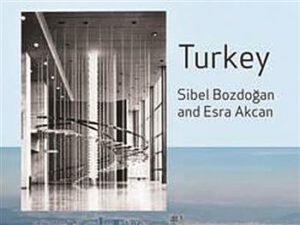
 ‘Turkey: Modern architectures in history’ by Sibel Bozdoğan and Esra Akcan
Reaktion Books, 2012, 40TL, pp 344
To study the development of modern Turkish architecture is, in a sense, to study the history of the modern Turkish Republic. It’s the story of how rigidly rational, positivistic and utopian ideas were ultimately redefined and reshaped by the centrifugal forces that they had themselves enabled. This co-authored book, written by two professionals in the field, does an excellent job of tracing “the evolving project of modernity” in Turkey through the prism of its architecture.
The authors divide modern Turkish architecture into three basic phases, the first of which mirrored the early Kemalist republic, in which monumental architecture was seen as an essential form of national expression to embody an explicit break with the discredited past. Given the nationalist narrative that imbued architectural practice in the early republican years, it is perhaps something of a paradox that almost all the most important architects working in Turkey at the time were foreigners. One of the most influential of these was Berlin-born Hermann Jansen, who won the international competition to design from scratch the new capital Ankara. Like so many urban plans at the time, Jansen’s was an ambitious and systematic plan to divide Ankara into strictly and logically demarcated zones. However, while traces of this vision of the city still remain, to visit the rather sprawling and chaotic capital today is to get a salutary lesson in how far it has departed from the utopian-rationalist principles of its modern founders, (in this sense, Ankara could almost be a symbol of the Turkish Republic itself).
Modern Turkey’s second, post-WWII phase witnessed accelerated capitalist expansion, industrialization, the transition to multi-party elections, and the hardening of Cold War geopolitical imperatives. It became a period of radical reshaping of city spaces, mass demolitions, new building projects, and rapid urbanization. In the absence of adequate planning for the latter – in the form of mass housing for new migrants – the first textural results of the urban boom were self-built “gecekondu” slum areas that proliferated in all the major cities. Later, these were gradually replaced by the more anonymous high rise “build and sell” apartment blocks that are so familiar in Turkey today. Considering this process, the book is particularly good on the effective negation of architects and city planners that the urban boom ultimately entailed: “Global cities of the late twentieth century challenged the modernist conception that urban growth can be planned or predicted … [They] are shaped exclusively by the proliferation of anonymous and nameless buildings, which in turn eliminates the designer-architect.” The second half of the twentieth century thus testified to “the elimination of the architect’s voice and control over Turkish cities” – a remarkable transformation when considered against the utopian ideals of the early republican architects.
The third phase identified by the book is characterized by Turkey’s post-1980s engagement with globalization and its renewed commitment to neo-liberal economic policies. The authors struggle to hide their dismay at the effect that these factors have had on architectural tendencies, and abandon the studiedly apolitical tone previously adopted. In doing this, they (consciously or not) follow the inverse path to that of the Turkish architectural profession, which was itself heavily involved in the fractious politics of the 1960s and 70s but has become increasingly depoliticized since 1980. The book emphasizes that Turkish architects of the last 30 years have fully engaged with dominant global postmodernist tendencies, departing from the traditional paternalistic Kemalist understanding of modernity. Their work is no longer defined by grand and symbolic monuments to the state, but rather by inner-city gentrification projects, new shopping centers, and “stage set” out-of-town housing developments. This is undoubtedly true, but I would also be interested to hear what the authors have to say about the current government’s plans to build enormous new mosques in symbolic areas of Istanbul such as Taksim Square and Çamlıca Hill. Such projects seem to be no less an expression of dominant state orthodoxy than the old Kemalist republican monuments – the only difference is that the definition of this state has changed.
In the end, this is a fine book that makes the story of modern Turkish architecture (perhaps unexpectedly) fascinating. Although intended for the specialist, it stays happily jargon-free and can be recommended to anyone with a healthy interest in modern Turkish history. Still, if you share the leftist political sympathies of the authors it’s not a particularly cheerful tale.
Recommended recent release
.jpg)
Princeton University Press, 35TL, pp 240